New Instruments
Humans become the musical instruments of God.
The divine spirit makes music through us.
~ Matthew Fox, Illuminations of Hildegard of Bingen
June 2025
I dream:
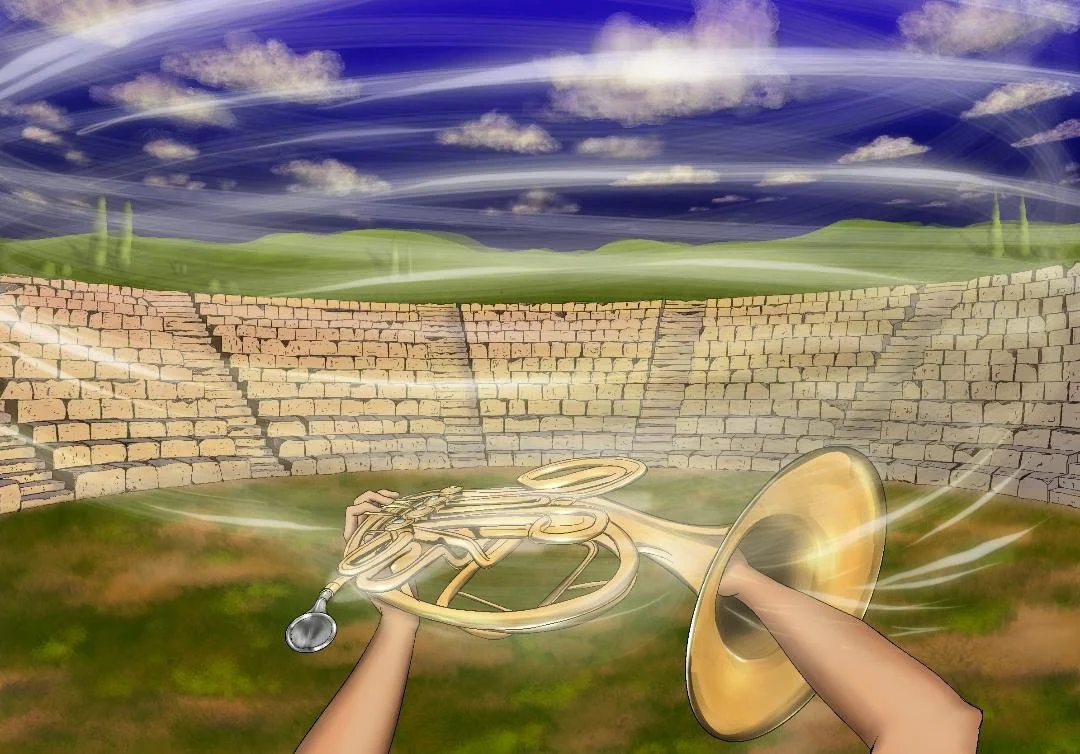
I am standing in a small amphitheater made of large rough stone – the kind that I saw on the Greek islands – spaces for outdoor theatrical ritual serving smaller, agricultural island communities. It is a strangely cozy, familiar space. There is a lovely late afternoon/early evening summer sky.
I see myself from behind - as if through a camera - sitting down in a folding chair in the center of the orchestra - a circle of grass. I seem to have a French horn in my lap. My right arm is crooked with my right hand in the bell of the horn. I watch myself from behind for a moment and wonder what this is going to be about and why I have a French horn.
I am now Martha in the folding chair – holding the horn. The theater faces west, and I know the ocean and the late day sun are behind me, I feel the warmth on my neck. The clouds in the eastern sky float in warm light.
The theataron seats are thankfully empty. This is a great relief, because evidently, I am supposed to play this thing, or learn to play it, and I have no idea what to do. I’ve never put my lips on a French horn before. I feel the difference in the keys, and the weight of the horn and the mouthpiece. Different because I did play the cornet for handful of years and I could probably still squeak out a scale. If the fingering is the same or similar between horns, it might not be too hard to get started.
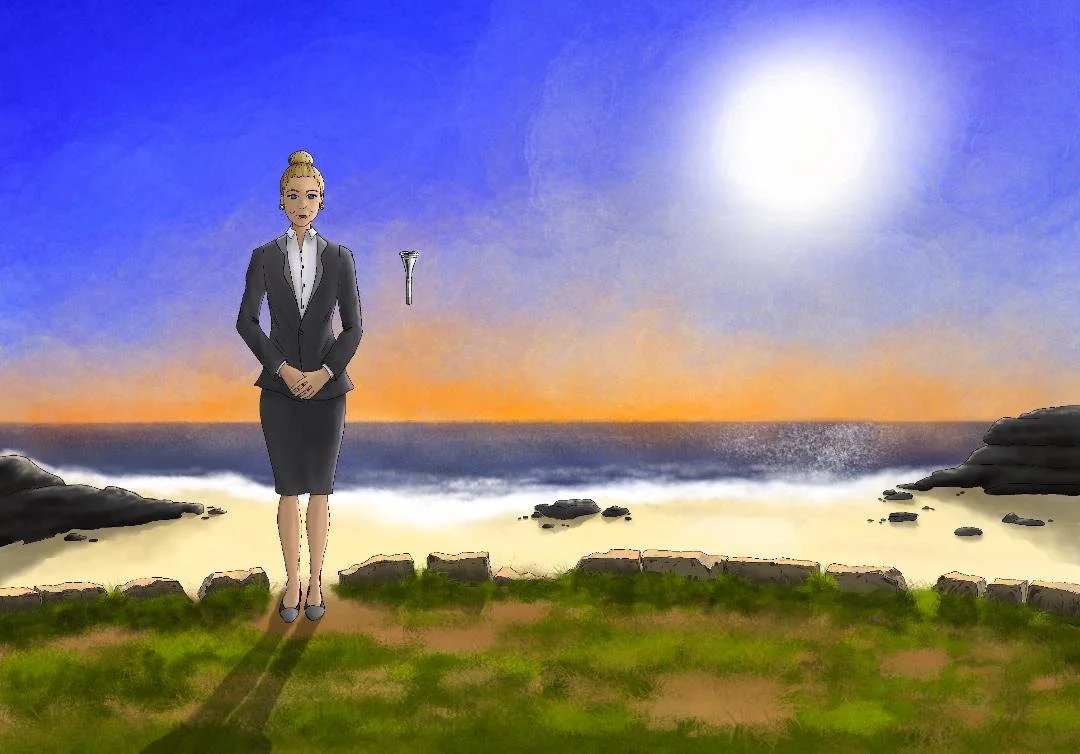
I feel someone standing behind me to the right, in roughly the same spot I was looking at myself from earlier. I turn to see who it is, and see a pretty young woman, dark blonde hair pulled back in a bun, a suit coat and a high collared shirt. “Professional” looking earrings, a skirt, and some kind of sensible pumps. Her outfit seems like something a twenty-seven-year-old might wear at her first important job where she wants to be taken seriously and compensate for her inexperience.
She asks me: “Do you have an embouchure?”
I reply: “No, I don’t have an embouchure for a French horn yet. I couldn’t possibly. I worked pretty hard for many years to develop and maintain a strong double reed embouchure for bassoon a long time ago, but it takes time to build an embouchure.”
She doesn’t know what a double reed is. I can tell from the blank look on her face.
I say, “ Like on an oboe?”
No recognition.
I then say: “You know, like the instrument that snake charmers play to charm cobras out of their basket –
“Oh, yes.”
I don’t know if she has any idea what I am talking about or not.
Maybe she just wants out of the conversation.
I had wondered at first if she was a French horn teacher who was there to give me a lesson, but it is clear that she isn’t there to teach me anything.
She has some other kind of job. Maybe she is the manager of this space, or maybe she works for the town historical preservation or event office or something. A guardian.
Someone must have needed to get her permission or needed her keys for me to be sitting here.
I refer back to the snake charmer’s punji:
“So that instrument –” I mime swaying back and forth like I’m hypnotizing a snake and fingering an imaginary woodwind
“ – has a double reed. I played bassoon through junior high and high school, and bassoons also use a double reed.”
And so, of course I also mime playing the bassoon. I squat like I’m sitting on the lap belt, holding a bassoon along my right hip. I curl my lips inward and tighten my chin, blow air into my cheeks to show her what the embouchure looks like – because at this point, I’m not even sure if she knows what the word means.
Maybe it just was a music word she thought of saying to musicians generally.
She doesn’t care about any of this. She doesn’t say anything.
This isn’t her business.
I keep going:
“Double reeds require a very particular embouchure – but a horn’s mouthpiece uses very different mouth muscles to play. And I’ve only just begun. It might be a little bit similar to the cornet – but I haven’t even blown on the thing yet.”
No response.
I turn my back on her, and it is just me, back in my folding chair, engrossed in holding the horn as before. I sit there and think:
“Well, I guess I’m just supposed to figure it out by myself. I remember how to play cornet from when I was a kid. Maybe it is similar? This isn’t going to be easy. But it might not be impossible. I’ve done and tried a lot of pretty hard things, and they’ve come out okay more often than not. Maybe I won’t be able to do it by myself. Maybe I will.”
But before I even try to put my lips to the cool silver mouthpiece, I gaze up at the seating, and up the hill behind it, and up to the sky. I take a deep breath, and I sink my attention down into my abdomen and imagine how beautiful, how delicious, one clear, long, true French horn note would sound ringing through the encircling acoustics of the amphitheater, spiraling higher and higher, rising up into the golden clouds into the deep blue sky, sending sound rings out in every direction across the entire island.
A shimmering sound.
I woke from this dream and immediately thought:
“Oh fuck. A French horn. This life is over. I’m dead. It is what it is.”
This may seem strange, but it’s not so peculiar if you know that I live with a unique cancer with no prognosis that went into a completely unexpected remission and that no one has any idea if or when it will come back. It’s actually a pretty common thought for me.
But this time the thought was highlighted by much more context: For some reason I’ve spent a lot of time thinking about French horns because I have a deep uncanny and emotional response whenever I hear one, and I started saying at a pretty young age that I would study French horn “next time” or in my “next life” without really understanding why I felt that way or even what I meant when I said it.
If I was dreaming about playing French horn it must be in my next life, and that meant that this one was over.
Remission over probably. I reviewed subtle body events over the past few months: No extra bruising, no falls, my balance if anything, has kept getting better. No new pain, numbness or paralysis. No extra headaches. Nothing that would justify trying to get the doctor to order a scan…
It was 5:15 in the morning. The dog had eaten something funky, and I had spent the night waking up intermittently to his whining urgency and taking him out to the dog pen. I rolled over from the post-dream meandering thoughts and as soon as my eyes opened there he was, standing next to my pillow, locking eyes, tail wagging, needing to get outside again.
As I walked up and down the driveway with the dog, I thought about all the instruments I had played, and hadn’t, and why:
I never played the French horn.
But the tone of them: a call to return to a long-lost homeland, music from a dream, the sound of a protective spell surrounding an adventurous heroine from an old Bohemian folk-tale.
A yearning for a world I never had the chance to live in.
“It’s okay.” – I’d think to myself – “I’ll get to play French horn next time…”
But even in junior high I’d notice the strangeness of the reflexive thought.
“Next time? What next time? The next time I’m in high school band? There is no next time.”
“Maybe I mean my next life...” Although I didn’t think that was likely either. In college and the cluster of “post-college” years when discussions of the afterlife emerged in the circles of young philosophy, theater, film and art students that I moved through I would occasionally share my strange after-this-life-French-horn thoughts.
Over the years whenever I heard French horns, in a musical theater score, on the classical radio station, in TV theme songs, or in concert halls - the strange thought persisted. And still emerges occasionally, over forty-five years later, when Apple Music pops a French horn piece into its free associative play list.
The reverberations bring about a change of being.
~ Gaston Bachelard, The Poetics of Space
“I’ll definitely play French horn next time…”
Bassoon (1978-1981)
My mother had at one time hoped to be a concert pianist, so piano and reading music were introduced very early in my home. I’d picked up my mother’s old cornet for a time, and then eventually bassoon – because I could already read bass clef and the school band teacher asked me if I’d be willing – and then also tenor drum in marching band because bassoons are too heavy to march with hanging around your neck.
I’d taken lessons weekly from a nun at the nearby mission, and frankly Sister E. didn’t seem to like me much. I was a kid who learning either came easy for or it never came at all and although I liked the strangeness of being the only child bassoonist for miles, playing the Elephant’s Walk at recitals with my knees akimbo in a pair of gauchos after a long line of pretty girls in lacy dresses playing flutes and piccolos, I had no intention of taking up bassooning as my life’s vocation.
My relationship with Sister E. (I am hesitant to name her or the mission town because I suspect she might be alive and would still hunt me down) soured further when she accused me of stealing her favorite reed knife and demanded that I return it.
Reeds are everything to a bassoonist. And there was no sense in paying for pre-made ones and certainly not the plastic ones that would just crack and buzz. A bassoonist needed a good handful of reeds at the ready because they could split if they were getting old or insufficiently hydrated with your spit before attempting to play them. Bassoonists are always sucking on double reeds that they have cut, shaped, bound with wire and wound closed intricately with brightly colored thread themselves.
Sister E had taught me how to purchase the raw reeds how to soak and bend it in half to form a double reed – like the oboe’s but larger. She taught me how to bind it tightly around a form and ream it so it would fit securely on the curved metal bocal. Then to work the two flat ends of the reed – to thin, scrape and shape them with said reed knife which I admit she absolutely had lent me – into responsiveness to lips, cheeks, tongue and teeth. Good reeds needed to give and soften in the right places but remain firm enough to produce a good buzz.
I didn’t steal her reed knife. I didn’t really want or need a reed knife because I was a half-assed bassoonist and frankly, I was fine with the shitty plastic beginner’s reeds but those weren’t permitted. I’d kept the knife for a time, as Sister E. had instructed me to, in the storage box in my purple fake-velvet lined bassoon case so I could make adjustments on the fly. I mean, I was in eighth grade. It wasn’t like I was ever going to experience a musical emergency in a full concert hall.
Maybe someone took it from my bassoon case, or maybe I left it on the kitchen table after making a few lopsided badly bound reeds at the last minute before bassoon class one day – but whatever – it went missing.
She hadn’t told me it was her “favorite reed knife” - or that I should handle it with special care or even that I should return it or that it was merely lent to me. I thought maybe it was covered with the price of lessons like the music books I was given to practice with. Maybe she thought we would have a long relationship, and I would be her bassoon protégé and she was bequeathing it to me, and it would pass back and forth between us and that it was “our special knife.” If so, none of that was clear to me. If was so special, she should have just pointed out which knife – in the bassoon reed mail order catalogue she had circled all necessary supplies in – I was supposed to get my mom to buy.
I had no idea where it was or when it had gone missing. I just been using a pair of scissors and a Swiss Army knife I’d found in the junk drawer to make reeds when I needed them – and I had no idea it was going to turn into such a big deal for her.
She wrote me letters for several years after I stopped taking lessons demanding that I repent and return it and apologize for my theft. But frankly my homelife was full of many kinds of dangers and living through every day was like crawling on the edge of a reed knife and a bassoon-playing-nun’s missing tool was really the least of my problems.
I wasn’t even Catholic.
Years later, after my mother lost our house to my step-father in a divorce where she had not bothered with legal representation, I came home from college to help her unpack after her move into rental. And there I found Sister E’s reed knife in the rarely used toolbox that had lived in the spider-filled garage with no light bulb in the old place - the sharp tip of the knife, used for scoring the reed, broken off. Someone in the house must have used the thin blade for something thick or wedged in a tight space and put it away thinking it was just any old Exacto knife. I mean – it really hadn’t ever looked “special” in any way.
I never responded to her letters. Life was too overwhelming to deal with an upset nun who had certainly already replaced a long-lost reed knife. The letters came intermittently once or twice a year, for longer than I would have expected.
I tossed them without opening them.
June 2nd, 2025
The day unfolded.
I emptied my inbox. I drank my tea:
Okay, maybe I’m not going to die soon… I surveyed my symptom profile again: No histamine or hot flashes. No changes in my vision. No weight loss or unusual infections. No indications that I had come out of remission.
I took a shower and saw a few clients before I got a chance to write the dream down and journal on it:
I am playing the instrument I thought I would only ever play next time, in my next life,
but isn’t the first time I’ve put my lips to a silver mouthpiece…
Cornet – (1972-1978)
I found it in the luggage closet in the basement, where my mother kept the off-season holiday decorations that smelled of candles and old dusty pine cones, and the big suitcase set we used on family trips.
There was a small hard case with a handle on top. All wrapped in leather that looked like my Dad’s alligator shoes. When I picked it up, I could feel from the weight that I was going to find something really cool inside.
I lugged it over to the couch in the playroom and popped open the two latches with sliding buttons. A shining golden horn with a silver bell, and three pearly valve buttons laid nestled in red velveteen. The bell was engraved with flowers, leaves, and something that could be a ribbon tied into a bow. Below were hand engraved words:
KING SILVER SONIC
Made by the H.N. White Co.
CLEVELAND OHIO
A mouthpiece dangled in a hole on the side of the case.
I raced upstairs:
“Mom! Mom! I found a trumpet!!”
“Oh, that’s my old cornet from high school. You can have it if you want…”
An old-time instrument from a long time ago when my mom was in high school. She was like thirty or something, so the horn was from the olden days.
I fussed and begged and even though I was only in elementary school and there was no band until junior high, she found some summer and after-school band program for me with group lessons by instrument and sorted into beginners, intermediate, and advanced. I would be the youngest by far, but I could go.
I could already play two handed on the piano so I knew how to read music and thought I might be able to hop right in and keep up with older kids who didn’t know how to read music yet.
I had watched Danny Kaye in The Five Pennies, The Red Nichols Story every single time I had found it listed in the TV guide. Red Nichols played cornet, that was why this horn had been a particularly exciting discovery! I had already asked my mom what the difference was between Red Nichol’s cornet and Louis Armstrong’s trumpet. She’d explained that a trumpet’s tubing is the same size through the whole trumpet until it flares out into the bell. Cornet’s tubing is narrowest at the mouthpiece and gets slowly wider and wider out to the bell.
I thought I could hear the difference. Red Nichol’s cornet sounded rounder, more graceful, more gentle and silly than Armstrong’s trumpet which sounded sharp and shiny.
“The cornet is fading away now,” Mom said, “everyone plays the trumpet. You don’t see cornets anymore.”
I would be the heir to a fading family tradition, preserving the ancient art of cornet playing.
Confident that I understood the basics – I arrived at band camp and discovered that was by no means ahead of the curve. I wasn’t even on the curve. Teenagers with moustaches, teens with bras were warming up on instruments that they could improvise on. I was the only second grader, and also the only girl in the whole brass section. Seated instantly last in the trumpet section.
One of the hairy higher chair trumpet boys took me outside and we sat on the lawn in the morning sun - and he taught me how to buzz my lips into the mouthpiece, like blowing a raspberry, like making duck noises with a duck call or playing a kazoo but by pushing air through your lips and letting them buzz against each other. And he taught me the scale and the fingering from middle C.
When I got home, I told Mom all about it, and that I needed to practice so I could learn all the notes.
“Here, let me see if I remember…”
She took the horn and played a perfect scale up and down.
How could she remember from so long ago? Did they even let girls play cornets in the olden days? All the girls at summer band camp played flute or clarinet or oboe. A couple of boys played clarinet. One older girl played saxophone in a section of all boys.
But there were zero boys in the flute section.
And I was the only girl sitting with the trumpets.
And I was the only cornet.
There were no French horns.
Also: I realized pretty quickly that I didn’t want to work all that hard at this.
I was having a lot of fun being the absolute good-spirited worst at something, and all these older kids were being pretty nice to me considering. A lot of them just ignored me which was also kind of nice. I just liked watching them all.
It was clear to all involved that I was no Red Nichols. Still, playing music in a completely average to bad and childish way was fun and meaningful to me. And really, all the stories in and around the music were more interesting to me than actually playing the music.
I stole my mother’s old Louis Armstrong albums and Dizzy Gillespe, and I turned up the volume for the band Chicago with their shiny horn section whenever they came on the radio. And although many don’t remember this but there was a big flugelhorn top 40 moment in 1977 when Chuck Mangione’s Feels So Good was inescapable.
The cornet was warmer than the trumpet, which was why I loved it, the flugelhorn was warmer than the cornet, and the French horn was the warmest horn of all.
I don’t know when it happened – but once I learned what a French horn sounded like I became an expert French horn identifier. In every television theme song, evening news intro music, every Aron Copland 1976 Bicentennial moment – I would point one finger first to my lips to shush others, and then in the into air near my ear and blurt out: “French horn!”
I didn’t practice the cornet over much. I practiced enough. Enough to be in a lower middle chair in the trumpet section which was really fine with me because in my heart I was always first and only chair cornet, playing my mother’s old horn. She had been the only girl too, swinging in my mind with Red Nichols, preserving a small gleaming piece of the old ways.
So, when there was a chance to shift from half-assed only-chair cornetist to half-assed only-chair bassoonist it was fine with me. I lugged a giant fucking bassoon case, more than half my height if you stood it on its end, up and down a steep hill, to school, to lessons. I practiced barely enough. I made my own reeds and learned about the history of the bassoon. Even found some albums in a used record shop of Baroque and Renaissance music featuring the bassoon’s ancestors – the contrabassoon and the great bass shawm.
But much to Sr. E’s consternation, none of that meant I would commit to the bassoon.
It only meant I found it interesting.
June 2025
I briefly investigated the history of the double reed and the punji that I referenced in the dream: That had all been summoned from some deeper layer than anything that I was conscious of beforehand.
Snake charmers do play an instrument called a punji that is in fact, a kind of double reed. I mean, it’s not hard to distill that from their sound if you have ever heard one played.
Animal protection acts have mostly driven the snake charmers out of India – snakes aren’t meant to live in baskets all day and they were allegedly kept in an intentional state of dehydration so that they were too weak to move quickly to strike or escape – but some communities still exist in rural areas and nearby nations.
Snake charmers weren’t a tradition of con men, although the traveling “snake oil salesmen” peddling elixirs via Medicine Shows in Europe and the United States probably iterate from a shared archetypal history of snakes and healing in Greece and India
Snake charmers dance with their tired-out snakes as a kind of ritual warm up and signage to attract you to the healing oils and unguents that they offer for sale. Snake charmers are traditional healers, magicians, those who could control deadly poisons and transform them into medicine.
There are very specific punji melodies that families and villages of snake charmers have passed on to each other. The scales and melodies they play, the buzzing of the double reed within the punji were said to convey blessings. The vibrations help heal the sick.
I’ve tamed a few serpents myself. Dabbled a bit in the healing arts too.
If I were taking the SATs I’d try this out: The punji, is to the shenai, as the shawm is to the bassoon.
A healing practice, a snake medicine, a magic vibration that has almost entirely faded away.
But has floated through my dreams more than once.
Through the brilliance of an image, the distant past resounds with echoes, and it is hard to know at what depth these echoes will die away.
~ Gaston Bachelard, The Poetics of Space
Journal entry:
June 2nd, 2025
On a small, lovely Greek island. It is Naxos. I know exactly where I am on the island, and when we visited the amphitheater.
An ancient space of collective ritual and transformation.
A preserved ruin.
One that few tourists know of or visit nowadays.
Not particularly impressive but very old. The locals don’t seem to use it much.
A forgotten space for theatrical and religious events
Unused, but guarded, locked, tended by keepers.
It is empty but not abandoned.
I am in the middle of the orchestra.
The center of the circle.
An altar at the center of the world and the birthplace of time…
~Olivier Clément, Transfiguring Time
When I woke from the dream, I was certain I had visited a ruin of a small amphitheater in Naxos. But when I looked it up in my travel journal – I discovered the spot was actually a ruined temple to Dionysus that my dreaming mind had transformed into an amphitheater. Amphitheaters are themselves sacred community spaces for Dionysus, so he is present either way. A place to honor the god who calls us into drunken, disinhibited, ecstatic love for the universe.
What musical offering am I supposed to make as an offering to the god of joy and ecstasy, chaos and madness, a divinity that transforms all those who he touches?
I don’t know how to play here. Or how I am supposed to figure this out.
Naxos is also a particular kind of sacred space for me. The site of a previous transformative dream of an ancient olive tree stump sprouting new shoots and branches. It was a place I traveled when I still felt quite disabled and was stable on chemotherapy but not in remission. I forged a new relationship to mortality there. It was Greece that taught me I no longer had to prepare either for living or dying because they they were always happening all at once.
A sacred community space.
I was granted some special permission to enter, although I don’t know why
and thankfully the space is empty.
I won’t be performing this evening, if ever.
I am here to practice, to prepare, to attempt something new that has perhaps been put off for far too long:
Raise a signal.
Let a sound ring out.
Send out a shimmering call.
Perhaps I was brought here to just learn about the acoustics,
how to stand in a sweet spot,
learn to produce and withstand the encircling vibrations and echoes.
I am in a seat in the dead center of the orchestra where any whisper, any noise, any sound I can produce will rebound back to me from all sides.
I don’t know how to start. And there is no one to teach me.
My imagination is my only guide.
Do you have an embouchure?
The space has a keeper, a manager, a protector who controls permission and access.
That is her only job, evidently.
I first thought I was there for a lesson, and that the young woman was my teacher.
She wasn’t.
She didn’t know about French horns, or about music.
She also didn’t know or care much about me, she didn’t know that this was the first time I had ever held a French horn.
Whatever is required it will have to emerge from within.
I can’t ask for it from the gatekeeper.
I should stop trying so hard.
To be fair to myself, I had dropped into these events mid-scene with no exposition like an actor’s nightmare. There was no introduction to the young woman who watched over and permitted me into this space.
I was psychoanalytically trained after all, for many years immersed in that theology before I took a turn toward more collective and archetypal models. I’d assumed the neutral young woman from the historical preservation society or whatever was all about me, there to help me and connect to me.
She was just doing her job.
I’ve experienced such archetypal functionaries before in dreams. They have a duty to execute and are not interested in the particulars of the personalities that they happen to be serving. They are following their form and assignment. Neither a help nor a hindrance.
It isn’t personal.
It is a primordial image, a poetic image.
A young woman who stands near the gates and keeps the keys.
Who tries to speak as little as possible.
But the strange way she used the word embouchure – so tight-lipped and decontextualized.
As if it was an object, you either had in your pocket or you didn’t.
I found her question about an embouchure strange, and aggravating.
But what if the question was just part of her job?
What if she was simply passing on a query that she had been told to convey, and it made no difference whether she knew what it meant or not? I did a whole ridiculous song dance, and mime, trying to connect and understand who she was to me.
She protects the place.
A place I abandoned, yes.
But also, a place everyone abandoned when the old gods faded away.
A place that is still empty and kept empty.
You have to need it, to care about it enough to ask.
Or for someone to ask for you.
Maybe even without you knowing.
I was to be allowed to step into this circle and to let something ring out.
She had let many others in before me and would allow many others in after.
This was just my turn.
What if I had just taken her question at face value?
“Do you have an embouchure?”
“No. I haven’t developed one. I don’t know how to play.”
What would she have said next?
When I told my husband the dream, he said this:
“I know what she would say. She would say, if she were allowed to, something like: “You already know. This is your true voice. You know.’”
Journal, June 2025
The word “embouchure” is repeated many times, over and over.
My mouth muscles are undeveloped and not yet fit for this new task.
The tongue, the jaw, the lip and cheek muscles, all are required, against the specific shape of the mouthpiece, to form a round pleasant timbre, to hold the pitch.
“Do you have an embouchure?” she asks. As though I might have left mine in the car or as though she might supply me with one.
I would be lucky, as a beginner, to even get my lips buzzing again.
I knew that if this is “next time” I would have to have built up an embouchure bit by bit, working on my facial muscles with consistent practice, carrying around a mouthpiece and buzzing into it habitually, learning to make the air flow more targeted, more precise, tightening my lips toward higher intervals
No, I don’t have an embouchure.
No, I don’t know how to wrap my mouth around it.
No, I don’t know how to speak it into being.
My mouth is unprepared for the task in front of me.
Or was it? It was pretty strange I was here at all with a French horn in my lap. Who knows if I’d been granted an embouchure to go with it or not?
“You already know. This is your true voice. You know.’”
I decided that I needed a teacher. I decided my mouth was not ready.
I did this reflexively, without testing anything out at all.
Immensity is with ourselves.
It is attached to a sort of expansion of being that life curbs
and caution arrests, but which starts again when we are alone…
We are dreaming in a world that is immense.
~ Gaston Bachelard, The Poetics of Space
Embouchure.
From within the mouth
The embodied and amplified resonance of the mouth.
A new embouchure for a dream instrument in my next life?
New sounds, new signals, a new tone a new call to wrap my mouth around?
Who am I playing for?
Who will hear this clarion call?
Who am I summoning?
What signal should I send out into the universe?
What walls will come tumbling down?
Who needs to locate me?
What dynamic reverberation am I able to produce?
What new era am I announcing?
What fanfare for the common man am I supposed to play?
What blast will be felt in all the worlds?
What message might I transmit?
What noise must I make?
What am I able to call into existence?
Who needs to hear me?
Who will respond?
Am I ready or not?
Open your mouth. Eat what I give you. ~ Ezekiel 2:8
We learn by mouth.
The most important stories on this earth were passed from earth to mouth, from sky to mouth, and from mouth to mouth.
I survived and built myself from words, and from the stories told to me.
We build the world around us with imagination and language.
Or as a friend on social media replied when I shared a snippet of the dream:
A mouth can speak.
A mouth can point in a direction.
A mouth can direct.
And yet, I don’t play, I don’t yet put my lips to the horn.
First, I imagine.
I sink into my mind’s ear, my mind’s eye and summon a golden tone I yearn to hear, that I yearn to play.
Imagination is a most secret power
that is as much of a cosmic force as a psychological faculty.
~ Gaston Bachelard, The Poetics of Space
And of course, this dream is mine and arrived in my consciousness in a package that was addressed particularly to me, as I am, with my own history and experiences.
But it is also a dream of a public space, and an ancient one and a forgotten one that belongs to no individual, only to the gods and to everyone.
And musical instruments, their stories, their resonance, their evolution and obsolescence are the stories of the death and rebirth of whole eras, and cultures. We can follow them back through time to lives we have never lived, but have inherited.
Paradise is hidden…
It is a state that is masked by time, and that can be rediscovered
~ Olivier Clément, Transfiguring Time
And as the era we have known crashes, collapses, out from under us, it is important to remember that primal forms and structures have endured through the centuries, that sounds at the right frequencies can travel great distances, in many different directions, and diffract around obstacles.
We are each an instrument.
And perhaps it is time for each of us to dream of a new instrument and rediscover the gifts of the ones that have faded away from common use but are preserved and remain with us in new forms.
Maybe life has curbed, and caution has arrested the sounds we release out into the world. Maybe we just don’t know how anymore, if we ever did.
Maybe we each have to summon a power so secret that we have forgotten we have it and finally let loose its cosmic force.
It is time to remember our immensity.
To call to each other across great distances.
To honor the surviving gifts of the gods and the ancestors and to make the next new sound.
It is next time, now.
And the walls come tumbling down.
You already know.
A mouth can point in a direction.
Do you have an embouchure?
Are you ready?
It is time to release the shimmering sound.
Your name, your sound can move us –
if we tune our hearts as instruments to its tone
~ Neil Douglas-Klotz, translation of the Lord’s Prayer