A Mother’s Curse
The Second Part
The mystical counter-experience not of dominance but of oneness, those of a different piety that is centered in women and the cosmos and nature-mysticism were attacked as upsetting the power and orders that be.
~ Dorothee Soelle, The Silent Cry: Mysticism and Resistance
The command to subdue the earth and subdue women’s bodies is the same command.
It is the desire to control all life-giving forces.
The creative forces of life itself, as manifest in nature, and in uteri are the most powerful forces on this earth. This seems to generate envy, resentment and destructive retaliation among those who cannot create and expand life, and who therefore seek to dominate it.
Progenitors, creators and the earth have been too patient for far too long.
Beware a Mother’s Curse.
I’ve been reading the Enūma eliš. It was made mandatory by a dream (which you might want to read first, or later).
The Enuma Elish is the earliest, oldest written text known to humanity. To read it is travel as far back in time as we can reach, perhaps as long ago as the Bronze Age, a story that the Bible absorbed into its own creation myth. A creator goddess in the saltwater seas – Tiamat – at the story’s center, the Biblical Leviathan.
In Genesis 1:2 she is simply called the deep.
Now the earth was formless and empty, darkness was over the surface of the deep, and the Spirit of God was hovering over the waters.
She is the dark formless - before creation exploded and light and sky erupted.
As Biblical books and chapters pass, Tiamat and her husband Apsu – the god of fresh waters - are transformed into dragons, male and female Leviathans, sea monsters who have lurked there in the watery chaos, long before all the creatures of the oceans, earth and sky, before day and night and time began.
Yet God my King is from of old,
working salvation in the earth.
You divided the sea by your might;
you broke the heads of the dragons in the waters.
You crushed the heads of Leviathan.
You gave him as food for the creatures
of the wilderness.
Psalms 74: 12-14, Oxford Study Bible
Jehovah sets boundaries on the seas.
And as you’ll see he wasn’t the first one. It happened before, just like that, in a story older still.
A story of the birth of the gods, the creation of the universe, and humankind.
I just grabbed the first edition/translation I could find: Enuma Elish: the Babylonian Creation Epic, by Timothy J. Stephany. I know nothing about him or his credentials. But thankfully the tone was contemporary and readable, as it’s been hard to concentrate lately.
You know, with everything. If it was too dense I might have turned away.
I’m going to try to tell you how I hear Tiamat’s story, now, in this moment. After that dream of Tiamat, who I knew nothing about, as we watch the forces of cruelty and dominance tear the world to pieces, as we prepare to survive the fall - or not.
It’s a tricky story, full of betrayal, plotting, resentment and matricide. A story of the intimate relationship between destruction and creation, of the universe splitting in two, of the domination, manipulation, eradication and demonization of a Mother Creator from the seas. The tale of the birth of dualism and order imposed and extracted from formless oneness, activating perpetual conflict that will last as long as the world endures. Or maybe not.
“The progenitor, Tiamat, the mother who gave birth to all.”
Do we remember her as anything other than a giant dragon-eel?
The goddess of the salt waters meets the Apsu, the god of fresh waters - and all the lesser gods are conceived through the brackish estuary, a meeting of two distinct worlds.
These god-children are a noisy and ill-mannered bunch. Their wild revels destroy Apsu’s sleep and unsettle Tiamat to her core, but she doesn’t want to say anything to them. “She just put up with it.”
But Apsu can’t function without his sleep and suggests to Tiamat that they should just destroy them all. She screams at him, as any mother would, and then regains her composure:
“Could we permit our own off-spring to be thus eradicated? Despite their troublesome ways we ought to put up with it.”
Apsu plots with his favorite son, Ea – “an insightful god” to kill the rowdy ones anyway. But Ea turns the tables, takes Apsu’s crown, mantle, and crushes his father under his feet. Ea and his wife create their own child in the fresh waters – Marduk, a super-god, enormous, powerful with four eyes and four ears and red flames coming from his mouth.
Marduk controls the winds, the dust, tornado and the tidal swell which relentlessly aggravate his widowed grandmother. Because of his might Marduk is recognized by all his aunt goddesses and uncle gods as their King.
“And Tiamat was agitated and unsettled both day and night.”
But she just bit her tongue and put up with it all once again. Letting them try her patience and test out their powers and do what they had to do.
But her god-children would not let her be. They scold and harangue her – they too are agitated by Marduk’s terrible winds, and they want their mother to stand against Ea and Marduk.
“It is not surprising you’re forsaken! Are you not a mother?”
Her rebellious and demanding children, who she has been so patient with, who she has not moved against even as they killed her husband, now wheedle and petition her to war with Marduk for their sake, so that they may have peace from his winds.
This is when Tiamat snaps. It is too much to bear. There is no position she can take, no patience she can summon. She has been relentlessly patient, too patient, for far too long. She knows Ea and Marduk, her son and grandson, are coming for her, and that there is no response that will preserve the peace.
She prepares for the inevitable show down:
“They will suffer great misery for they chose to do evil to the gods that gave them birth!”
She brings forth great monsters and lets them loose upon the world: A horned snake, a mushussu dragon, a lahmu-hero, an egallu-devil, a mad dog, a scorpion man, umu devils, a half-man-half fish, and a half-man-half bull.
All the gods have defected to Tiamat’s side in this conflict.
Ea and Marduk stand nearly alone against her with only a few potent allies. Ea is confident that his mother will be destroyed by his son.
Why? Why is any of this necessary?
“She is like a deranged maniac!” Ea says.
“No matter how strong a woman, she cannot equal a man!”
This rage, this abuse is as old as the oldest written story in the world.
Destroyers, dominators cannot bear creators.
Marduk accepts the challenge to claim “the power to both raise up and compel down” over this primordial world. He rides a chariot of storm clouds to mask his advance to the battle ground. The horses that pull his chariot are named like Santa’s reindeer from hell: Killer, Merciless, Fleet, Highflyer, Blitzkrieg, Clasher with Total Extermination leading the way.
He arms himself with a bow and arrow, a mace, a net, and his many winds: a terror-gust, tempest, whirlwind, the four gales, the seven winds, the tornado and the hurricane to capture the “rampaging” Tiamat.
“But Tiamat worked her magic, with no need to avert her gaze”
It was only when Marduk suggests to Tiamat that she should calm down, and think about being a good patient forgiving mother for once that she totally loses her shit for good:
“For what reason do you displace this superficial benevolence, When in your heart of hearts, you generated a force for war? Only because your sons, the gods, were making such a noise. Only because they have been inconsiderate of their forebears. But why ought you, who gave them birth, not forgive them?”
She bawls at the top of her lungs in an unstoppable rage. (who wouldn’t?)
“Her viscera trembled al together to her very foundation. Undeterred in discharging her magic, she then spoke the spells.”
A mother’s curse.
Marduk’s winds force her screaming jaws open wider and bloat her belly. Marduk’s strikes her middle, he cleaves her in two and cuts open her heart “bringing her hateful life to an end.”
Who hated whom exactly?
He treads on her body, pulverizes her skull with his massive mace, slices open her arteries. He splits her cadaver into pieces “flaying it in half like a drying fish”
But Tiamat is the monster? Right?
From her body parts he builds the stars and constellations, built arbor lined pathways using her ribs, her liver becomes the crescent moon. Her saliva becomes the clouds in the sky and the rains that fall. From her head he forms the mountains and springs and streams emerge from her wounds. The Tigris and Euphrates pour out from her eyes. Her breasts form treeless hills and fells, her thigh becomes the central post which hold up the skies.
He then makes Humans to take on all the labors that have previously belonged to the gods, because gods shouldn’t have to work so hard.
Yet, villainized, pressed to the brink, seemingly destroyed and defeated - Tiamat remains the source of life, mother of all, and her remains continue to sustain all living things.
She is the creator of all and the very stuff, (matter and mater) of all creation.
~~~~~~~~~~~~~~~~
There are two systems at play in this conflict: A patriarchal hierarchy ruled by gods of domination. A life-giving oceanic matriarchal world of interconnection and creation that keeps creating life even in death.
Maybe this is simply a story of the emergence of dualistic thought. An early demarcation line between Creator and Creation. In Silent Cry: Mysticism and Resistance, Dorothee Soelle sees such dualism as the necessary underpinning for domination and supremacy.
Maybe the Enuma Eilish is simply the story of the emerging split between the hierarchies of monotheism and a “formless” inclusive pantheism. Maybe this is a story that attempts to explain a world of social hierarchies and dominance, human systems where power is the only thing that matters, as it all seems to unfold in a universe where every single component is imbued with energy as a creative force that flows through every living thing.
A patient earth, that tolerates all that she can until she breaks.
Pantheism contains an element of anarchy, one that undoes domination. ~ D. Soelle
A vision of God as wholly other, wholly masculine, wholly supreme, the top of the hierarchy. And that vision lives alongside an invincible if wounded story of sacred holy ground, all of us and all species as siblings, born from the same Mommy Water, a life-force that fills the earth and sky and rocks and trees and can never be separated from it. The whole Universe as the body of the primal Mother.
Maybe our dualisms will finally exhaust themselves:
Various dualisms derive themselves derive themselves from [the split between Creator and Creation] in particular those that like to think of themselves as in accordance with creation: man and woman, soul and body, human and non-human, spirit and matter, as well as the unbridgeable social dichotomies as parents and children, masters and slaves, whites and people of color…
Sexism feudalism, racism, class-domination and the desacralization of nature have again and again used this dualistic either/or in the dominant understanding of God for their purposes. ~ D. Soelle
Maybe this is why they felt they had to destroy her, and why they still do.
Maybe this is why they cannot just leave us alone to make decisions about our own bodies.
Maybe this is why they want to force women to breed at their pleasure.
Maybe this is why they want to annihilate their forbears.
Maybe this is why they hate their mothers so much that they want to destroy all creation, all those who create and preserve life, and the earth itself.
Primordial formless fusion was first disrupted and then destroyed by hierarchical order and dominance.
Might this be the end of the cult of Marduk, a final attempt to dominate creative forces that continuously burst forth with life, and that they thought, they still think, they can stifle and smash to dust?
But still, even the rocks and stones cry out.
Maybe that is the mother’s curse that flew from Tiamat’s lips and that Marduk must one day face: That she in truth, can never be destroyed, but will always and eternally give birth to something new.
What might that new thing be?
What new worldview might be born next?
It will not be a return to the primordial seas, or a binary world ruled by dominant, envious super-gods.
But perhaps some new, evolving integrative schema. Or something old, that has always been there, that cultures of supremacy by-passed, or never matured into. Maybe one that incorporates both our uniqueness and our indisputable entanglement? One that rejects primal dependency, and isolationist individualism, while it celebrates healthy autonomy and interdependence?
Can we dream our way to a world on the far end of Marduk’s reign?
A world that understands, viscerally that we cannot destroy the other, or the earth without first destroying ourselves.
A world that we create together, calling on all the ancient mothers and creators, drawing on the deepest, most elemental life-giving forces
from the depths of the salty seas.
before you go:
I have been reading through liberation theologian Dorothee Soelle’s text, The Silent Cry and writing two essays a month about what lights up for me for the Lectio Subscription Essays.
If you find Soelle’s ideas here interesting you may want to take a look.
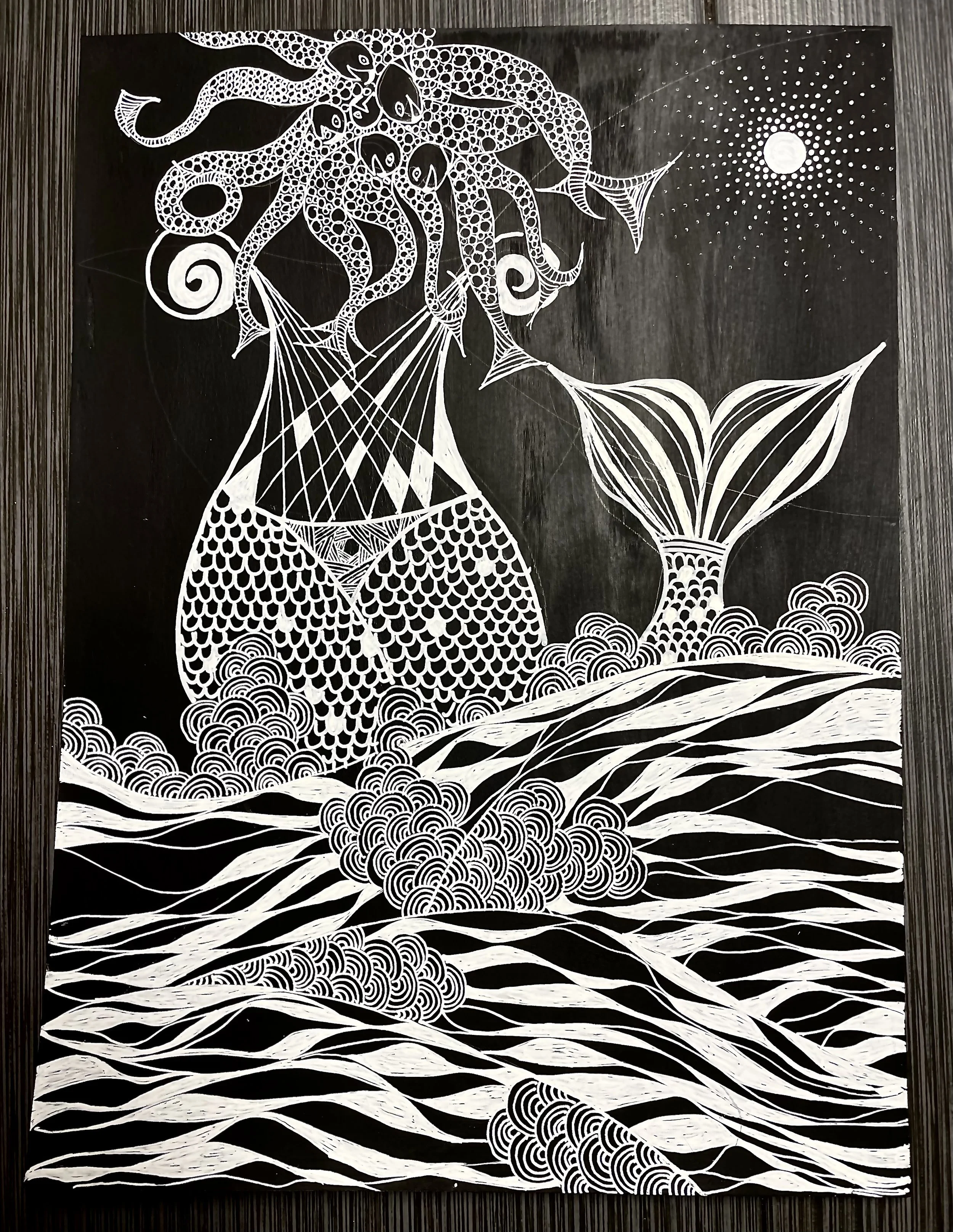
Also the gorgeous image by shea is representative of several pieces that are for sale here