Community Group Work in the Boston Globe
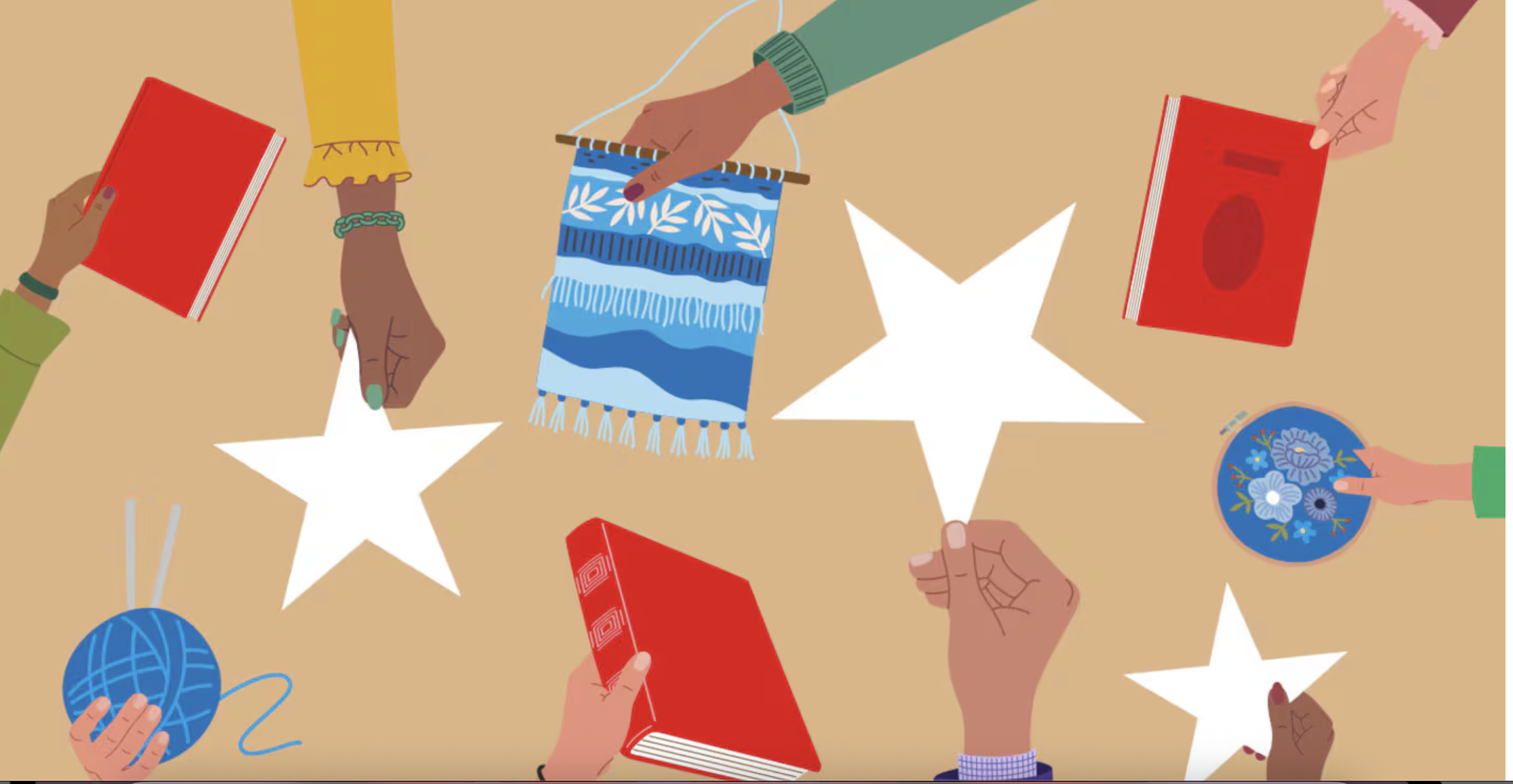
Illustration by Luis G. Rendon/Globe Staff; Adobe
Journalist Elizabeth Svobada and I had a lovely conversation about the role of community groups in healing our collective pathologies
You can read it in the Boston Globe here, or copied below!
Thanks so much to Elizabeth for her thoughtful write up!
How book clubs and knitting circles can restore our democracy
‘Group whisperer’ Martha Crawford aims to help Americans revive in-person engagement skills that have gone dormant.
By Elizabeth Svoboda
Updated March 19, 2026, 3:00 a.m.
Elizabeth Svoboda, a contributing writer for Globe Ideas, is the author of “What Makes a Hero?: The Surprising Science of Selflessness.”
On a weekend afternoon, attendees around the country are gathering virtually to take part in an experiment: a first-of-its-kind forum for incubating new community groups and helping them thrive.
The steward of this unlikely gathering is Martha Crawford, a New Mexico-based teacher and social worker who’s also a kind of “group whisperer.” Today’s workshop supplements Crawford’s ongoing series of “group group” meetings, designed to help people create small-scale collectives that bond and sustain members. Some of these fledgling community groups revolve around particular themes — supporting adoptees, reading fiction, learning to knit. But for Crawford, each one has more profound functions: connecting people to local sources of support they lack and reviving habits of engagement and exchange that have been on the wane for decades.
This kind of grass-roots group-building, research suggests, can be a potent antidote to authoritarian drift. “Strong leader” desires and far-right-wing attitudes can arise from deficits in belonging that lead people to see the world as threatening, while people who feel more socially connected are less apt to endorse such extreme views. Group participation also promotes the kind of civil give-and-take that strengthens democracy in the long run.
“Once people learn how to build small groups without harming each other,” Crawford says, “it begins to seed and resuscitate a collective ability to function as a healthy whole.”
The rapid pace of social change has plunged Americans into community limbo. With rates of attendance at religious services dropping, fewer people are experiencing the solidarity and meaning that faith communities once supplied. The root structure of secular group standbys — Rotary Clubs, veterans organizations — has likewise withered. “If we look at our elders and our grandparents and our great-grandparents, there were quilting circles, and there was the Lions Club,” Crawford says. “We’ve let all of that atrophy.” These social shifts have made it more difficult to forge genuine connections, threatening our mental health and well-being. Though millions of people turn to social media for community, platforms like Instagram encourage users to seek status and applause rather than common ground, leaving many feeling more isolated and adrift than ever.
Skillful local group-building, Crawford argues, can help reverse these trends, fortifying us individually and collectively. What’s more, secular groups offer many of the same mood and social benefits as religious ones, so long as they allow people to connect with others and collaborate in ways that have meaning.
Yet Crawford also understands people’s anxiety about trying to connect across differences. For years, facilitating groups was the last thing she wanted to do. While training in social work, she dreaded her group-based classes, wary of tension and conflict. “I actually was like, ‘I don’t want to go. That’s just going to be layers and layers of wacky,’” she says.
But as Crawford worked with a variety of clients, including those released from prisons and other institutions, she saw how oases of community support helped them thrive: reentry groups, job-skills groups, groups for processing grief. And later, after Crawford adopted a child from Korea, she launched a community group that turned into a lifeline for her and her son. “My son said, ‘I want an adoption class where there are only adopted people in it and nobody else,’” she remembers.
Thanks to her connections, Crawford managed to pull together a support group that worked on two levels. Young adoptees counseled one another through the struggles they were facing, and their parents and family members met separately to discuss their own challenges. That group’s success fueled Crawford’s desire to seed community groups elsewhere. “It just became clearer and clearer to me that there were structures I remembered existing that suddenly had disappeared out from under us,” she says, “and that we needed to build and create them.”
Like her regular “group group” gatherings, Crawford’s latest group-building workshop, which she is letting me observe, offers would-be community leaders tools they can use to manage groups without getting too stressed or overloaded. Along with her cofacilitator, psychologist Deserie Charles, Crawford addresses a range of concerns from attendees. One of the most common sticking points is the discomfort of stepping up to launch a group in the first place.
“The idea of starting a community — being like, ‘Hey, let me put up some posters and invite some people to get together’ — is almost completely my idea of hell,” says a woman named Diana. “The responsibility associated with that is just paralyzing.” It’s normal, Charles assures the group, to fear this kind of overwhelm. One way to head off that prospect is to set clear expectations that group ownership will be shared, so that no one member becomes the locus of responsibility or blame.
“It’s like, do you want this thing that I’m doing?” Charles says. “And we can do it together.” Crawford stresses that when members slide into roles that suit them (scheduling meetings, guiding discussion, sending emails), keeping groups going shouldn’t be a heavy lift. “There’s usually somebody who loves Excel sheets — who wants to organize that stuff, and volunteers, too.”
“I’m scared of not being taken seriously,” another participant admits. “Not necessarily that I will be inadequate, but that other people will find me inadequate.” Crawford urges her not to worry about projecting gravitas. “I really want to help people reverse out of the notion of expertise in this setting,” she says. “Because it’s not necessary. I think the call is to gather in community around shared needs.”
To smooth out any group conflicts that arise, Crawford often advises her mentees to try Quaker models of dialogue and also the “talking stick” model used in some Native American cultures. While these approaches differ in some respects, both favor gradual consensus-building over heated debate. Each person shares their viewpoint, one by one, and by the end of the process, all members have a clearer sense of what the community stands for and what it doesn’t.
“There are lots of community structures that can help us be grounded together, where we’re not fighting, where we’re not dominating each other,” Crawford says. Once those structures are in place, she adds, the benefits of belonging multiply. “Ten people have many more resources and many more perspectives and many more opportunities for creative solutions than one person.”
That kind of prolific exchange also helps keep creeping autocracy at bay. Public policy experts Catherine Herrold and Khaldoun AbouAssi, who study nongovernmental organizations, report that locally based supportive groups strengthen the civic skills that sustain free societies. These groups “promote democracy by serving as public arenas,” the researchers write, “spaces in which members and beneficiaries build and practice democratic habits such as discussion and debate.” Such growth and engagement happen in part because social safety encourages greater tolerance. When people feel less lonely, according to a University of Arizona study, the world around them feels less threatening — and they’re less likely to endorse right-wing authoritarian ideas like “There are many radical, immoral people trying to ruin things; society ought to stop them.”
In groups where people feel “safe, seen and cherished,” as Greg Boyle, founder of Homeboy Industries, a gang rehabilitation program, puts it, members also gain deeper appreciation for what others around them are facing, which may motivate them to address broader community needs.
When Spanish citizens behind on their mortgage payments gathered in local support groups, reports the University of Hamburg’s Nikolai Huke, their shared challenges spurred them to lobby for fairer national eviction laws — and also organize flash mobs to keep families from being thrown out of homes. In this way, group members once overwhelmed by “feelings of failure, guilt, loneliness and uncertainty,” Huke writes, “have been able to become agents of political transformation.”
At the close of her group-building workshop, after helping attendees resolve their challenges, Crawford points back to the existential significance of the work they’re doing. Many South Americans, she tells them, formed tight-knit local groups in response to repressive leadership — and these strong connections and relationships prepared them to mount collective resistance later on.
As people revive dormant habits of give-and-take, “those group skills, and those organizational skills, and those collaboration skills spread,” Crawford says. “It’s one of the ways that communities that have become very, very disempowered and isolated and fatalistic begin finding their traction again.”