The Dreaming Soul
The dream is not only a spiritual phenomenon par excellence, but also the most subjective and mystical of all mental phenomena, and a phenomenon more inclusive than the dreamer himself, because it allows him both to observe himself, and to be at one with the universe. ~ Rank
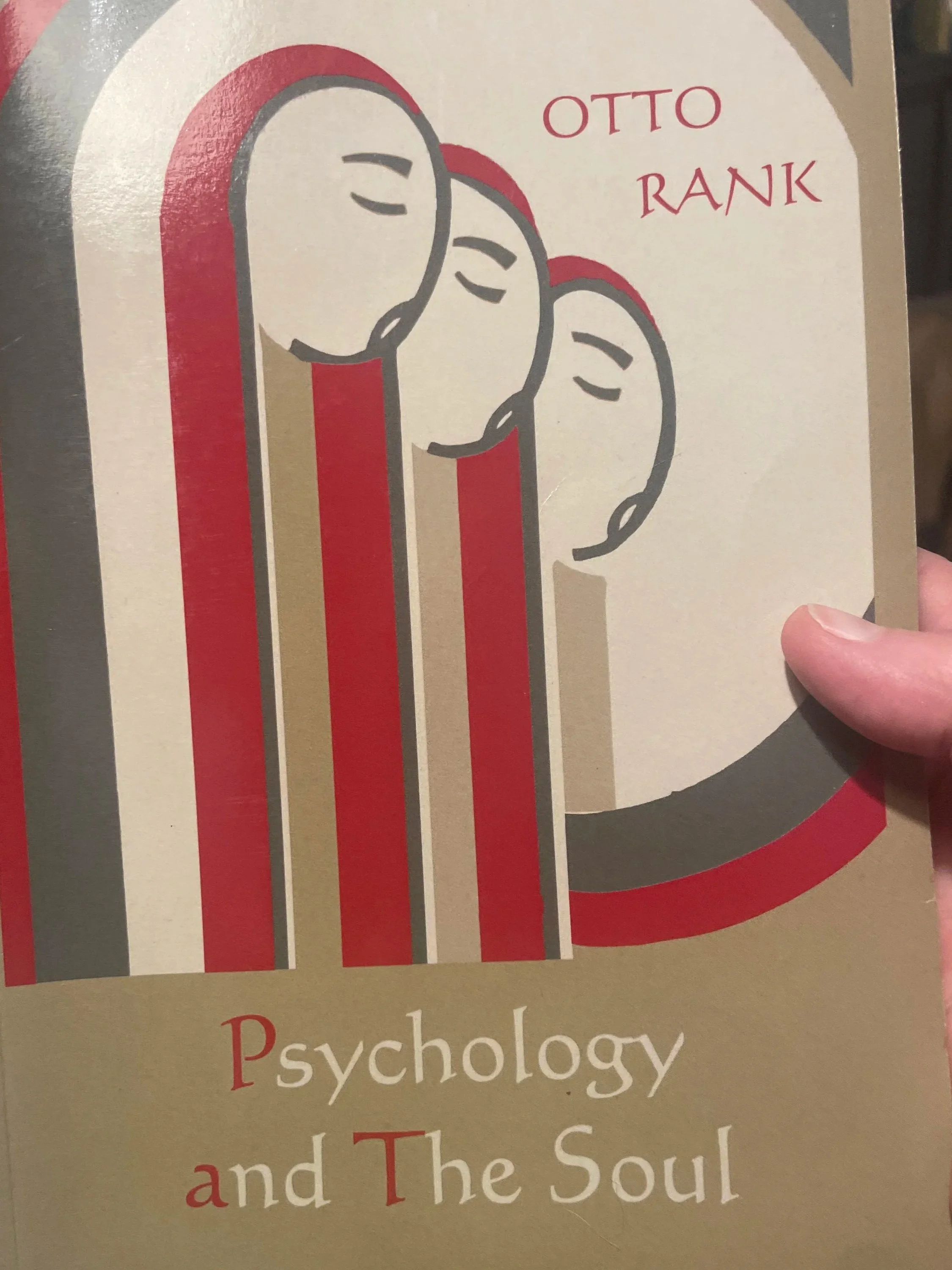
Continuing on an Otto Rank binge, I felt nurtured by his chapters Religion and Belief in the Soul, and Dreams and Reality in his book Psychology and The Soul.
A cool breeze in a feverish era.
What follows is an entanglement of Rank’s notions and my own on the various functions of dreams in our souls, bodies, communities, and cultures.
Rank suggests that dreams are a likely source of humanity’s notions of an autonomous and eternal soul.
And why not?
Our dreaming souls fly through the galaxies, across dimensions, ages, realms. We are reborn each night in a new scenario, in new bodies and identities, we fall in love, and raise whole families, and grieve the death and loss of entities we have never encountered on this earth.
And the dead come to visit us in our dreams.
Just last night I was in New York City where I lived for thirty years with my dead mother, who I had forgotten was dead, but who was still quite ill and moving at a pace determined by the deep ache of sickness and disability. I was both patient and impatient with how slowly we were walking.
Dreams come to us wearing a costume of objectivity. In the course of an unfolding dream, unless we break through to lucidity, we generally accept the premise and exposition of a dream at face value – however dismissive we may be in waking life.
My dead mother who was not yet dead, my long-gone little children – in actuality young adults living on their own in another state – were laying on our backs together in a store front “meditation room” on Lexington Ave, looking up at ratan light fixtures hanging from a ceiling painted black. The straw mat that covered the floor smelled of sweet incense. A man from India, a kirtankar, was chanting. I knew all the words and melodies and chanted with him.
While dreaming I accepted all of this absolutely at face value. As fact. It wasn’t “only a dream” as I was dreaming.
Psychoanalysis stresses the dream but denies the soul ~ Rank
Dreams are a spiritual phenomenon, an inner world, a higher realm, or a lower one, a continuous nightly rebirth, a punishment for the guilty, a journey to a multiverse or a microcosm, a series of trials, a brief glimpse of an alternate world that transcends the facts of daily life.
As we get up to leave the meditation room the man asks me to conduct future kirtan sessions in the space and become a part of the storefront temple. This seems both rash and desperate. He doesn’t know anything about me other than my familiarity with devotional song, and I don’t even know the name of this place. I smile and nod and am non-committal. We walk on leaving this place behind.
We have nightly experiential “evidence” of how having an autonomous and eternal soul feels, no matter how we wish to align our knowledge and beliefs with the scientific methods.
Our dreams assert that they have divine significance whether we believe in divinity or not.
Religion is just as good a psychology as our scientific psychology is a doctrine of the soul which it denies. ~ Rank
Many wake up and deny that their dreams are meaningful. But dreams go right on insisting that they have meaning whether we can discern their meaning or not, whether we “believe” in dreams or consider them nonsense.
Perhaps we are too concerned with the meaning of the dream, too focused on understanding and dissecting it, at the cost of simply allowing it to perform its personal and social functions.
The vast majority of people I have encountered, including myself, have had dreams that have changed our lives, dreams that gave shape our fears and phobias, dreams that have told us truths we did not want to face in the daylight, dreams that contain forgotten bits of memory, dreams that help us heal ourselves, or warn us of danger, or show us a pathway toward hope. Dreams that we treasure, hide, or at least preserve in our memories – dreams as actual, and sometimes formative life events.
Dreams, for me, are spiritual events where I may find responses, but probably not answers, to my prayer-questions. Who am I? What is being asked of me? What path should I follow? What should I leave behind? Where does my course need correction? What have I overlooked? Where do I need to heal? What am I grieving? What do I need and yearn for? How does my personal story intersect with the spirit of the age, the present-day challenges and realities, that I am embedded in? What is mine alone and what is all of us?
Dreams are where my soul tries to talk to me, and I try to contemplate and respect the message, even if I can’t easily understand.
As I walk along with my not dead mother, my eight- and nine-year-old not young adult children run ahead of us on the sidewalk. I tell my not dead mother how overwhelmed I am trying to take care of my elders and my children at the same time, and that the kids have weekend activities in Brooklyn and it is getting harder for me to come spend weekends with her on the Upper East Side in this city I no longer live in.
I don’t know how to do it all, I tell her.
Dreams may reshuffle, reorganize, and reconstitute memories allowing us to understand in hindsight what we failed to recognize in the moment.
Dreams become a “real” part of our lived history when they manifest as action, or when we recognize their correspondence to reality.
Many years ago, before I was a parent to these adults, I found myself popping into a notions shop on the walk home from work. Needles and threads, silks and linens, embroidery hoops and quilting fabrics. As I stood in front of a walk covered with a rainbow of DMC cotton floss, I suddenly remembered a forgotten dream from the evening before of sitting at my grandmother’s kitchen table and quilting with her.
The dream had guided me into the shop before I had recollected it. I honored the convergence by purchasing supplies for a needlework project, a skill I had learned from my grandmother as a child and had forgotten about for decades.
Both dream and action were unintentionally confused by the tendency to make them agree. ~ Rank
Dreams and reality may coincide, compliment, or compensate for each other.
When our dreams and reality deviate, is it reality that is edited to conform to the dream? Or has the memory and meaning of the dream been edited to conform to daily life?
I think the answer here is yes/and, both.
We may dream of optimal worlds. And of worst-case scenarios. If we pay attention, we may find ourselves reaching for one or preparing for the other.
Our dreams may mark or anticipate the conception of children, or the death of a friend or family member thousands of miles away.
Dreams can function as doctors – diagnosing body problems
Dreams may operate as nature guides – allowing the voice of nature to emerge within us - where animal, tree and plant spirits, both menacing and beneficent remind us that we share strengths and limitations, and capacities.
Dreams may offer alternate views of the past, the present and glimpses of potential near futures.
There is a wedge-shaped park at the far east end of whatever cross street we are walking along, with a very large tree in it. I notice a large photo in a silver frame has been lodged up in a crook high up in the tree. As my kids and mother head over to some benches, I climb the tree to reach the frame, and I take it down. The silver is tarnished; the glass is dusty and spotted and it needs to be cleaned up.
I decide this is my job.
Ancient dreams seed new ones, that take up the old forms and breathe new life into them.
Spiritual material is the essence of the dream ~ Rank
When our collective dreams have gathered themselves together, been shared and transposed into myth, fairy tale and religious practices, or eventually calcify into cultural ideologies, those dream-born but now concretized institutional ideologies exert their own force upon our dream lives.
The frame is large, maybe 18 x 24 inches, holding a black and white photographic portrait of Michelle Obama. She has long braids. I see it was taken on this very street. The photographer was positioned near the entrance of this park, facing west, as Michelle was walking eastward toward the camera and the park.
Dreams may serve as oracles – issuing warnings and predictions and prescriptions for communities, cultures and whole nations.
Dreams are teachers and storytellers, spinning allegories and parables shaping our moral and spiritual development.
I wipe the glass with my sleeve I find myself transfixed by the vital street scene behind Michelle, the background somehow exactly as in focus as the foreground.
There are neighbors wrestling with recycling cans at the curb, talking and arguing, cars and delivery vans double parked, a locksmith helping someone who has lost their front door keys, a bicycle messenger swerves through the intersection behind her. The street unfolds behind Michelle in a straight line past First Ave, toward Second Ave, and disappears into a horizon of street trees and store fronts.
This street feels so alive it fills my heart with devotion
Dreams may deliver messages from the gods, guardian spirits, and ancestors, or from the soul itself.
A pair of white sheer curtains are flapping and blowing out of a second-floor window behind and above Michelle’s head. They are strangely beautiful. They look like wings. Magic curtains dancing in some strange spirit wind, an exhalation, that will be inhaled and exhaled again by all the dogs, trees, squirrels, people, vehicles, flowers in flower boxes, old folks and children on this living street.
This is an essay from the Lectio Essay and Group Membership,
Membership at any level gives you access to the full subscription archive (which also includes over one-hundred and fifty “Seminar” essays about psychotherapeutic considerations and explorations of Jungian texts, as well as the Lectio essays which stay nearer to contemplative themes.
As a subscriber you are also welcome to contact me with questions about anything I have written, or to suggest subjects and prompts you would like me to elaborate on. I will try to respond to every question that I can, integrating a reply into into an upcoming essay.
A discussion group is offered the last Friday of every month for any subscriber who would like to attend intermittently or regularly
11:00am Pacific, 12:00noon Mountain, 1:00 Central, 2:00 Eastern
Funds from this affordable subscription help me to subsidize and sustain the free and by-donation support services I provide to people experiencing financial hardship - both in groups and individually.
Subscribe for two essays each month: contemplative writing prompted by the metaphysical, theological, mystical, esoteric and depth psychological texts that I happen to read for fun, sharing whatever lights up.