For All The Marys
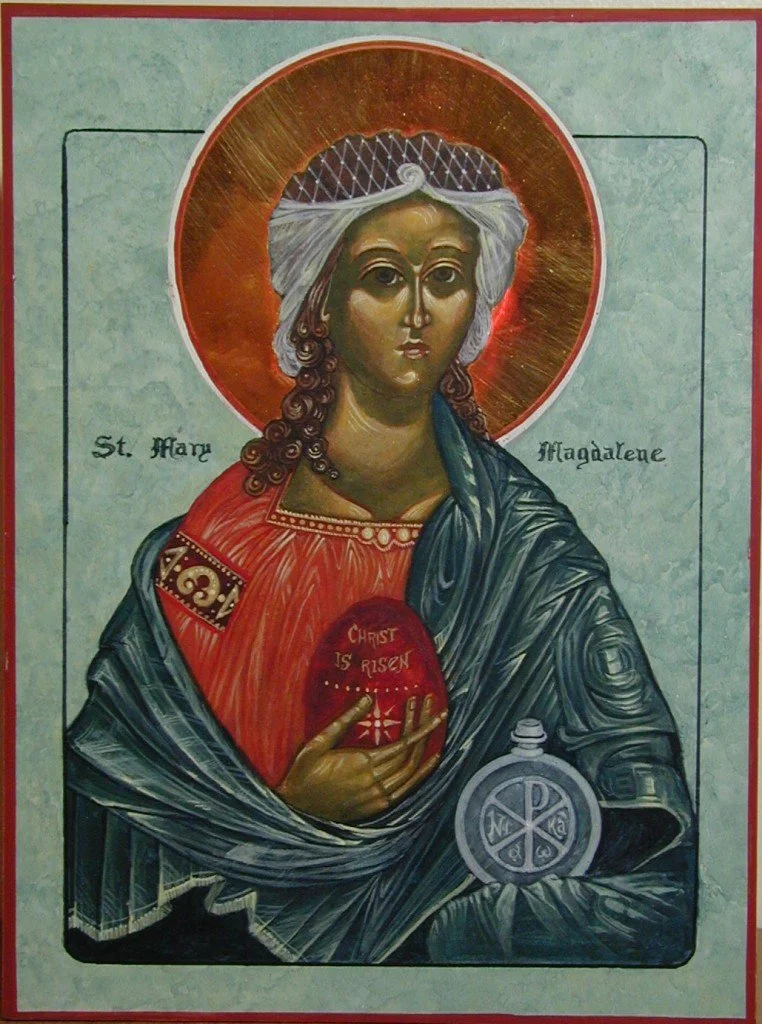
The whole history of western civilization is epitomized in the cult of Mary Magdalene. For many centuries the most obsessively revered of saints, this woman became the embodiment of Christian devotion, which was defined as repentance. Yet she was only elusively identified in Scripture, and has thus served as a scrim onto which a succession of fantasies has been projected.
In one age after another her image was reinvented, from prostitute to sibyl to mystic to celibate nun to passive helpmeet to feminist icon to the matriarch of divinity’s secret dynasty. How the past is remembered, how sexual desire is domesticated, how men and women negotiate their separate impulses; how power inevitably seeks sanctification, how tradition becomes authoritative, how revolutions are co-opted; how fallibility is reckoned with, and how sweet devotion can be made to serve violent domination—all these cultural questions helped shape the story of the woman who befriended Jesus of Nazareth.
~ Who Was Mary Magdalene?James Carroll, June 2006, Smithsonian Magazine
A dream:
There is a modern-day feminist cult centered on Mary Magdalene and her Gospel. I decide to attend the first free lecture because the leader is also an authoritative scholar on the Magdalene literature, and I am interested. I drag my husband to attend with me.
I am annoyed at the lecture because the scholar is incredibly well researched and informed, and an excellent teacher – but she had a very narrow agenda and saw herself as a primary authority, as an expert who had claimed this space as hers, as if Magdalene could only speak to her, or come through her.
A group of women worship her in a creepy way – and I am annoyed by her seeming “ownership” of this content. I performatively whisper in a crisply-articulated sotto voce to my husband and to anyone in earshot:
“Magdalene belongs to everyone!”
When I woke, I honored the unconscious need to make deeper contact with this Mary and decided to order a copy of Karen King’s translation and discussion of the Gospel of Mary of Magdala, This has offered relief, unsettled some internalized oppressions, provided comfort, and affirmed some deep exasperation with the relentless entanglement of patriarchy and Christianity.
It has also been a reminder that challenges to this misogyny are as old and older than Christianity itself.
I will tell you first of another essay I wrote, long lost, formatted on some obsolete word-processing code that no laptop has ever been able to read, written in my mid-twenties, before the internet, before blogging. I wrote it when I was 21, as a writing sample hoping that I could cold-call present myself at Parabola Magazine and see if I could volunteer or intern there somehow. A meeting was arranged, and a conversation was had.
I was rejected as I have so often been by institutions and organizations that I admire from afar. I was earnest, and callow and I was surprised by how deeply it stung, even though I knew it was a long-shot.
My essay had been about Magdalene at the tomb, and what I imagined her secret lessons were. My notion was that what was psychologically required of Mary was similar to the dilemma that Kirkegaard saw in Abraham’s attempted sacrifice of Issac. Abraham had to believe that Issac would die by his own hand, and to simultaneously believe that Issac would be a father to nations. Mary was also required to hold two impossible and contradictory truths at once - that Jesus was dead and crucified and had willingly gone to his own death which she had witnessed every moment of – and that the man she seemed to think was just a groundskeeper at first was the same Jesus, alive and speaking to her. She was not to foreclose one truth for another, or flicker back and forth between one belief or another – but to tolerate the impossibility and dissonance of them both at once, by herself.
And when she proved able to do so it opened her up to withstand the next mystical layer of teachings that would have been incomprehensible to her had she had split her perceptions into a tidy dualism or foreclosed on the intolerable tension.
Maybe she saw him first because the Twelve were not yet capable of comprehending this, and they needed to be inoculated, prepared to see the impossible.
She was then required to communicate this non-dual, non-linear, message - a magical disruption, and axial reality - that Jesus was both simultaneously dead and alive to the male apostles – and none of them could understand or accept her experience as true.
That was the gist of my writing sample and I based it on a close reading of Kierkegaard and the mentions of Mary I could find by name, flipping through the gospels of the King James Bible (again, no internet). And that was my relationship with Magdalene– as an old girl/young woman setting out into the world, trying to find a path other than waiting tables, trying to withstand all the impossible contradictions that surrounded me, and who had encountered almost no one else who was even vaguely interested in withstanding impossible, contradictory realities.
I hadn’t read or even heard of the Gospel of Mary.
I also didn’t know the mythical story still told in Eastern Orthodox traditions – nothing to do with these salvaged bits of her Gospel – of Mary and her egg - why she is so often depicted with an egg in her hand. I wouldn’t encounter that story until I did some googling after that dream.
I had no idea that Mary’s egg has been the archetype behind all the generations of dyed eggs at Easter.
The myth says that Mary, after everything with all the rising from the dead and dealing with the twelve had been settled, brought a chicken egg, (boiled or not there is no saying) with her to an audience with the Roman Emperor. The egg seemed to be used as a teaching prop, to convince the ruler that “Christ is Risen!”
The emperor laughed saying that a dead man returned to life was as probable as the egg in her hand turning red.
Which of course, right then, it did.
So here we are dyeing eggs for Easter - but not for Mary of Magdalene - we do it to honor a giant ghost-rabbit? And how did I never hear this story until I was over sixty years old?
When my kids were little, I just made stuff up to explain the holiday rituals that we didn’t really celebrate in our agnostic/atheist Jewish/Quaker household – except for the annual dying of eggs:
“What are the eggs for Mom?”
“Easter. It’s a Christian holiday – but you know Quakers don’t really celebrate holidays and Dad is Jewish. An important part of the Christ story for Christians is that after he dies on a cross - which was how they executed criminals in Rome – Jesus rises from the dead.”
I didn’t tell them Mary was the first one to see him. I didn’t cross my mind. Why would it?
“But what are the eggs for Mom? And the rabbits?”
“Well, the rabbits maybe because all the animals have new babies in the spring, new life after the dead and cold of winter – and the egg? Let’s dye the eggs in honor of the Great Mothers. All the Goddesses and Saints like the ones we saw at the museum. And all the Marys.”
When my brother’s child was a wee one, we all went to a Quaker meeting together – and after listening to a small handful of messages and prayers the little one stood up like the adults had and said: “Lord, Lord, Jesus, Jesus. Why doesn’t anyone talk about any girls around here?”
For those who can hear and take these stories into their hearts– and for no one else.
And how deeply relieving to learn more of this Mary and the gathered traces of her stories. The depth of the relief gives me a clear view of how important it was to erase her; how dangerous her story is to the organizing principles and oppressive forces of the history of the Western world.
And how the dominating forces that we are facing now, that wish to stifle the self-actualization, intuition, intelligence, and power of non-maternal feminine autonomy have always been there.
And have always been resisted.
In Mary’s very own gospel she is devalued:
A brief synopsis: The apostles are gathered after the ascension. They are terrified that they will be persecuted and killed too, if they go out and spread the word of The Good (the gospel’s language) as Jesus had asked of them.
Peter asks Mary for some comfort, and to share some of the special teachings she received. She hugs and comforts them all and tries to share the mystical teachings Jesus shared only with her. No one interrupts or asks for clarification or even a question. You can almost feel the apostles glazing over through the ancient script on fragmented papyrus.
(Oh, how I recognize this experience, trying to share some vision that feels as though it possesses and transforms me and that must be shared somehow. Those who glaze over. The men who can’t tolerate or won’t even consider what I am saying, the specific sensation that comes when my gender stops their ears from hearing.)
When she is finished, Andrew insists she is lying and made it all up. Peter agrees and insists that Jesus would never require that they listen to a woman or place one above them.
Mary cries at first – but she is fearless enough, clear-eyed, and with Levi accompanying her, she heads on out to spread the love of The Good as commissioned by her beloved, flesh dead/ spiritually alive teacher.
“I was set loose from a world and in a type, from a type which is above and from the chain of forgetfulness which exists in time”
~ The Gospel of Mary
Of course she had to be erased. Of course, Pope Gregory the Great had to insist she wore unguents and perfumes because she had previously engaged in “forbidden acts.” Of course she needed to be portrayed as demon-possessed, as unclean, unbelievable, unreliable because if the fullness of her story was available and sanctioned - the world as they knew it, maybe even as we know it now, could have been turned upside down.
A Jewish woman from Magdala, a woman of significant, independent means, a patron subsidizing her teacher and his followers. His dearest companion. A most trusted member of his inner circle, a keeper of advanced mystical knowledge, a leader among all the women who followed him, the first one that the resurrected spirit revealed himself to and who spoke to her. Who did what she was called to do despite the lack of belief and support of her fellow apostles, never listed in their official ranks. If she was granted all of her capacities, her autonomy, her power, her vision, her understanding - the options for all the women throughout the centuries raised directly and indirectly underneath these Christian mythologies would expand far beyond the Madonna-Whore dyad.
The most disruptive tales would be deemed heretical, and in the sanctioned stories Magdalene would be demeaned, disbelieved and contaminated, eventually requiring that the culture at large to ask a magical egg-laying rabbit to take over her role.
It would mean that women like me could have access to a sacred and more varied cluster of Marys to help us apply the gifts we have been given for The Good’s sake. It would mean that a self-directed woman who lived in her body, who smelled good, who had her own resources, as well as a fearless mind and a powerful heart, would exist backwards through time, for all of us who didn’t hear enough about her.
But no one, in her time, in any of the stories, would really listen to her. Not even at the very beginning. She went ahead anyway. The work she undertook was between her and The Good. It was never between her and them. She didn’t need them to understand or for some Catholic Church in the far future to tell her story whole and complete. That wasn’t her ambition. She didn’t require that.
She did what she was called to. She taught anyone with “ears to hear” what had been given to her to share with the world.
If they didn’t listen, if they didn’t believe – although she wept at the sting the first few times it happened – I’m sure she soon learned that the outcome and effect on others was simply none of her business. It didn’t matter who disbelieved or was threatened by her.
What mattered was who she could reach. It mattered when she crossed paths those who needed what she had to share. It mattered to play out her gifts; to honor all the hard lessons she had learned about Power and Love.
Millions still dye and decorate eggs with her behind them, before them, around them, guiding them – whether they know it or not.
She belongs to everyone.