What is Death?
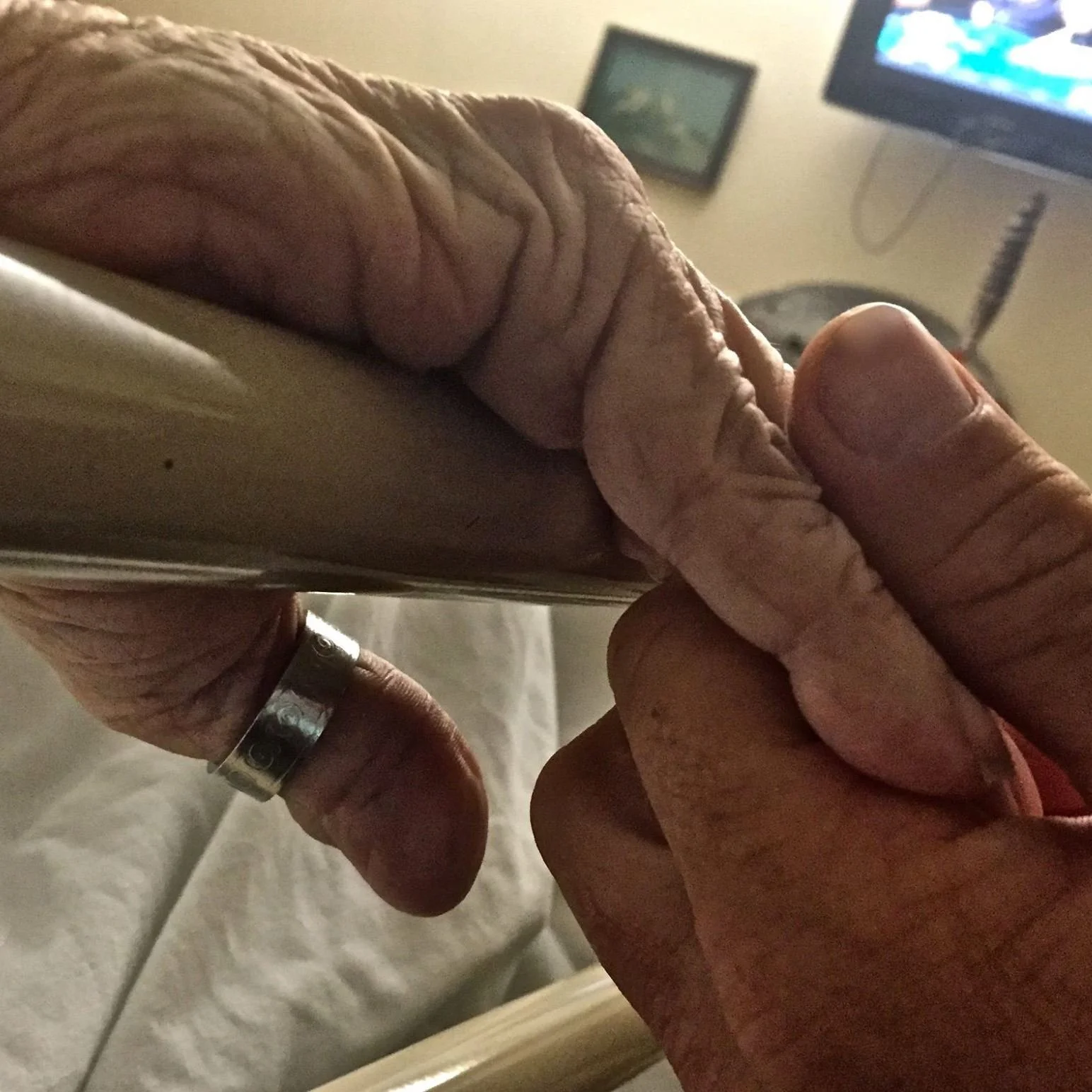
my mother and brother
Death is only frightening if we identify ourselves with who we have been in life.
I’m reading a strange, lovely little book by Arnold Mindell - one that never crossed my path before even though he has written, and I have read many of his writings.
The book I am citing and contemplating is titled Coma, The Dreambody Near Death and it is a small but rich account of the therapeutic process at end of life – where Mindell advocates for skilled psycho-spiritual support of those experiencing comas, unconsciousness and stupors in what are often considered terminal medical states.
I would like you to believe in whatever is happening to you.
Many would think that an end stage coma was literally “too late” to bother with any kind of psychotherapeutic process – but Mindell is a physicist and a clinician who has never retreated from extreme experiences or altered states.
But I also know, having sat at the bedside of those who were dying, who were sleeping, that the visions, dreams, hallucinations of the dying were pregnant with meaning, and this text made me consider how I might I might have supported friends and loved ones better or differently with regard to the psychological and spiritual aspects of their dying process.
I think of comatose patients as human beings going through one more meaningful step their process of individuation.
How might we die, or care for the dying if we saw these states and experiences as legitimate, necessary labor in service of self-actualization?
Let me tell you about some of my mother’s final days- (I’ve talked about this in my Mortality Workshop but I’ve never written this part down I don’t think?) She was hallucinating a great deal, moving in and out of time, backwards and forwards through her memories. Sometimes she seemed to be a young girl talking about classmates and neighbors who I never met, sometimes she was a new divorcee, heading out into the world on her own with three young children. Sometimes she was in the present, with me, in the hospice – but in a far more magical setting than the room swirling with disinfectant and the various smells that a body makes as it shuts down.
For her the room was filled with glorious birds and magical cats, which she seemed to understand were hallucinations: “I see cats, but you don’t see them, I think. There is one right on your chair, but you’d notice it! So, it must just be me that sees them.”
She was delighted by them. I asked her a little about what they looked like, and found it pleasant and relieving to see her so happily entranced but for some reason they didn’t activate my curiosity. I saw the cats as guides to elsewhere, as signs that she was simply “losing touch with reality” and engaged in the process of leaving us, leaving me, behind.
I thought of these visions and hallucinations as a kind of medical malfunction, the output of a mechanistic brain that was firing strangely as she deteriorated. I’d worked with client’s dreams, daydreams, psychedelic visions and psychotic hallucinations for over twenty years, and never once considered them arbitrary or haphazard. Every image shared I had regarded as meaningful and important and worthy of exploring.
But, because my mother was dying, I must have considered her growing process to be over and done with. I didn’t wonder how these experiences might be an active part of the story of her life, or the process of coming to know herself and her time on earth more deeply. I didn’t ask her why she thought the cats had come, or how many there were, or if she thought they wanted something from her, or if they had something to tell her, or if they were doing something for her.
How strange that I didn’t cherish these visions as important - as I had all the other kinds of altered states I’d encountered in myself and others.
The near-death stupors and comatose states I have worked with often produce symbols of mythical trips to other worlds. Many of these patients venture to the heights and depths to find some degree of prophetic insight and self-knowledge.
I saw them as merely silly and sweet. How sad that I missed this opportunity.
She was, in Mindell’s words, journeying through the outermost gates of reality.
Why couldn’t I see that until now? I’d spent so long pushing back against mechanistic, deterministic, dismissive and reductive models of dreams and visions and altered states. Why didn’t I recognize my own lifework right in front of me as my mother negotiated this strange realm?
It all felt impossible in the moment, but I think now, it might have healed us both in ways that mattered deeply.
Here is something else that happened:
She kept seeing beautiful writing on the wall. “It’s so beautiful Martha, in an ancient language like Aramaic or something. Gold calligraphy! Are you sure you can’t see the writing on the wall?”
“Well, Mom – we are in a hospice. I’m pretty sure everyone who is in the building can see the writing on the wall.”
She laughed a little “Oh stop!” but was transfixed: “But this is really something. I wish you could see it! Isn’t there something about writing on the wall in the Bible, in the Old Testament?”
“I can look it up – “ and I opened the top drawer in the hospice nightstand and sure enough, there was a Gideon Bible, just where you would expect one. I googled a bit to find the chapter and verse and flipped to the page and read it through quietly to myself.
Daniel 5:
King Belshazzar held a great banquet:
Suddenly the fingers of a human hand appeared and wrote on the plaster of the wall, near the lampstand in the royal palace. The king watched the hand as it wrote. His face turned pale, and he was so frightened that his legs became weak, and his knees were knocking.
The king summoned the enchanters, astrologers and diviners. Then he said to these wise men of Babylon, “Whoever reads this writing and tells me what it means will be clothed in purple and have a gold chain placed around his neck, and he will be made the third highest ruler in the kingdom…
Then all the king’s wise men came in, but they could not read the writing or tell the king what it meant...
So, Daniel was brought before the king:
“You did not honor the God who holds in his hand your life and all your ways. Therefore, he sent the hand that wrote the inscription.”
“This is the inscription that was written:
mene, mene, tekel, parsin
“Here is what these words mean:
God has numbered the days of your reign and brought it to an end.
You have been weighed on the scales and found wanting.
Your kingdom is divided.”
Ooof. Belshazzar was dead the next morning.
“Did you find it? What did it say?” she asked.
“Oh nothing, Just some old king who wanted his dream interpreted.”
The next day my mother entered her final, speechless, wild-eyed agonal hours and days.
Here are the questions I am asking myself now, as I sit with Mindell’s words:
Why couldn’t I think of death as a powerful time for learning? Filled with the drive to reach for unfinished business? As a time where we may have an awe-inspiring opportunity to accomplish seemingly small tasks that are central to a life mission?
What if the ending is the most important part? Our last best chance to attempt to be exactly who we mean to be?
Maybe this was the moment I could have helped her avoid some of the suffering that was to come. Maybe if we had done this work together, it would have been less terrifying for her to let go, and she wouldn’t have been trapped for so long.
My mother’s days were numbered. There were many profound moral and maturational failures which created excruciating consequences in her life and in the lives of her children. My mother had never once attempted to come to terms with or take responsibility for any of it. Never said oops! Never said sorry. If you weighed it all up, as much empathy as I had for her, she could be found wanting.
The schism and estrangements in the family were multiple – including among those of us who would survive her. The kingdom she would leave behind was divided.
I wasn’t going to hold her accountable on her death bed. I had no need to punish her. I was afraid if I read it out loud, it would be like slapping her in the face. Maybe it was just too terrifying to see my most primal resentments expressed by the Daniel the prophet?
But now, I wonder – what if, like Belshazzar, she needed the writing on the wall interpreted? What if she needed these words, and her psyche had summoned them, so that she could face the terror and initiate a single, final, reparative gesture?
For her sake far more than mine?
What if I had read the words to her, and simply asked her what she thought of them? She had, over the past several days, named many things she was proud of in her life (many of the highly questionable accomplishments: her formerly flat stomach, the disastrous affair she had that made “all of them jealous”). What if, as she was getting ready to go, she was also trying to come to terms with her regrets? How did she feel to leave behind a family broken in pieces? What did she want to release and be done with? Where was she scared she might be found wanting?
What if this was the sticky unfinished work that made it so hard for her to let go the last seventy-two hours, while she sat awake, alert, rhythmically gasping, terrified and trying, but no longer able to speak?
As she moved her lips urgently and silently I just said to her over and over: “I know mom. I know everything. I know every single thing you would ever want to say to me. I know it already. It’s too hard for you to talk. Believe me, don’t worry. I know it all Mom. I know.”
I just assumed that what she was trying to say was whatever I most yearned to hear from her - from out of her very best shining moment, her highest self. And I do think it was in fact what she wished she could have said and been, but was too afraid before, and was too late now.
What I didn’t know, was that I might have actually missed a potentially, transformative, healing moment with my fiercely loving, needy, burdensome, hilarious, annoying, messy, foolish, ruthless, mother…
Why do I feel a sense of urgency in writing this book? Is it because I am fighting for a new ethics?… Or do I need to study near death experiences in order to discover my own timeless self?
I was her brutally exhausted daughter after all. I wasn’t her end-of-life psychotherapist.
Still - I wish I could have asked her to believe in whatever was happening to her.
I wish I could have believed in it with her.
And even Mindell writes self-consciously and carefully, tentatively about this “unusual work” as he knows how ripe it is for dismissal, for accusations of projection, for medicalized, mechanistic contempt, as too woo and ridiculous and simultaneously too real and too powerful for most of us to be able withstand.
The intensely vital, lets-stick-the-landing, bring-it-on-home inner-processes of death.
The term death implies a new process. It means we should begin cleaning up our present situation as best we can and moving on with the new process that is trying to happen.
I couldn’t do it then. I was just being initiated to this world of death-study.
I think I could do it now.
For me there is no life and death anymore, there is only the process of becoming yourself.
This essay is a free preview from the Seminar and Lectio Essay Series