Of Mama Lamas and Shaggy Dogs: (a real story in two parts)
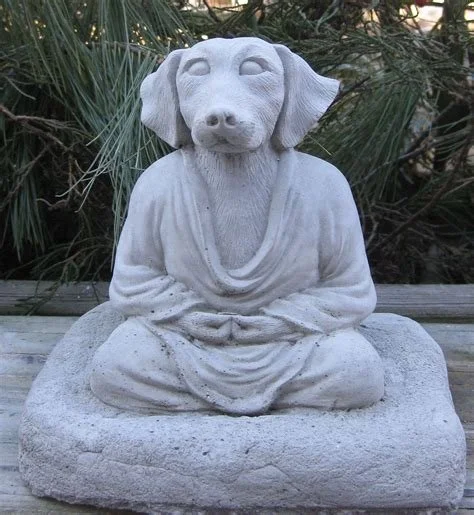
I rarely rely on Wikipedia for a citation, but in this circumstance, I think it is totally suited to purpose:
Shaggy dog story: In its original sense, a shaggy-dog story or yarn is an extremely long-winded anecdote characterized by extensive narration of typically irrelevant details and terminated by an anticlimax.
I am absolutely telling a shaggy dog tale - because I think that our wish for stories to proceed in a straight line and end with a satisfying climax has little to do with living, and that our notions about what parts of a story are relevant or not are skewed. Sometimes the most important part of a story lies in the details we dismiss as unimportant. Sometimes a story has greater power if we consider it an unfolding process that we are immersed in, that will emerge, recede, and reveal itself to us over time without a button at the end.
So, if you want to read a story with a clear driving narrative and a tidy ending you might want to pull out now.
This is just a story of living in a whirlwind of randomness, catastrophe and the miraculous and paying attention. Of noticing patterns and variations in patterns, and felt experiences of fluid meaning, but with no certainty or desire to pin down what it all means.
It is a long circular tale of coincidence that begins far away in time and space and lands right back at my own feet.
PART ONE
It begins, as best as I can discern, in New Jersey, in 2019. Or maybe it starts in 11th century Nepal, or somewhere in between. I’m not entirely sure. But in 2019 I packed up a shelf of journals and notebooks which I had written in, almost frantically through two and a half years of chemotherapy, because my brain was so cloudy, and I could remember so little.
One journal had a page in the back titled “To Read/Research” with a list of titles and names. About halfway down the list I had written the words: Machig Labdrön – whatever that meant. Something I had jotted down reading something forgotten. I had no idea what those words or sounds meant, or what language they were in.
I tore the page out and stuck it in the text I was reading. I didn’t plan to go back to these journals for a long time. I dropped them in a moving box, taped it shut, uncapped a black sharpie, and wrote: “To: Santa Fe, Downstairs, Office, Closet” so the movers would know where to deposit it when all our belongings arrived at the new house in New Mexico.
Once we were settled and unpacked and a little oriented in our new home and new life, I stuck the list of things to be investigated in a wicker inbox on my desk. Over the next few years, I worked my way down the list: Texts by Vine Deloria Jr., Arnold Mindell, Mary Watkins, James Hillman. Collected notes of Jung’s seminars and his letters arguing with theologians.
A few years later I finally reached those strange words: Machig Labdrön. Where had they come from? Some footnote maybe? Something I’d seen at the Rubin Museum, which had been one of my favorite public havens back in New York? Maybe some Sufi? Or someone I had read about in a back issue of Parabola?
No idea. No bells rang. Memory holes left by cancer treatment seem to have stayed with me long term, and never filled themselves in.
But I slapped the words in a search engine and up it came. I ordered Jérôme Edou’s book titled: “Machig Labdrön and the Foundations of Chöd.” I had no idea what Chöd was either, but from the book cover I could tell it was probably Tibetan Buddhist practice. When it arrived, I added it to my stacks.
Life rolled on, another year or so passes. I settle into the unexpected cancer remission - (that allowed me to leave the cancer center and the rare lymphoma specialist in New Jersey and move to New Mexico in the first place) that had a less than fifteen percent chance of sustaining itself beyond a year or two. The kind old oncologist I found in Santa Fe, who seemed like he might retire at any moment, didn’t have experience with rare cancers, and certainly not unique ones. I knew that if something went wonky, I would have to get myself to the Arizona Mayo Clinic or to MD Anderson Cancer Center in Houston. But I seemed to be holding steady enough. The occasional concerning test seemed to return to normal a few months later. But over time, and with enough accumulating small irregularities the nice old remission-babysitter became increasingly concerned and suggested it was time to go back on chemotherapy. He suspected that remission was breaking down.
There was no way I was going back on that stuff without extensive testing and consultation with experts in rare manifestations of leukemia/lymphoma. When you have a leukemia that presents only in your cerebral spinal fluid and as lesions on your spinal cord and never showed up in your blood or bone marrow you need to find the very best guessers in the medical field.
A few miracles of kindness, good fortune, fate, and privilege allowed me to book an appointment in Houston a few weeks later. I expected, at best, to undergo a week of painful and debilitating tests that I had faced many times before: spinal taps, bone marrow samples, hours, and hours in MRI’s (on valium for claustrophobia) and PET scans. Dread-full even if the results turned out to be good ones.
My dear friend Catherine arranged to join me for the week in Houston, both of us assuming I’d need assistance- while my husband was helping our kids get moved to their new schools, new lives, new cities.
I packed a suitcase of garments without metal hooks, clasps, or zippers, so I didn’t set the medical machines or myself ablaze, along with several pairs of the silliest, silkiest, most colorful, and comfortable pajamas I could find at the local Dillard’s.
I looked over my stacks for a book for the journey.
What was I hungry for? What did I need? What would accompany me well on the journey back into the jaws of mortality? Something that would summon bravery and perspective. Courage and acceptance of all potential outcomes. That left a mere five or six books in the “to read” pile of archetypal studies, liberation psychology, and mystical writings of various belief systems.
And there was Machig Labdrön, dancing over some dark deity, decorated with bones from a charnel house. I looked over the blurbs on the back cover:
“Chöd refers to the cutting through the grasping at self. Most famous for its teaching on transforming the aggregates into an offering of food for demons as a compassionate act of self-sacrifice, Chöd aims to free the mind from all fear… “
Sold!
I remembered an essay I’d written years ago, long before “The Troubles” descended but perhaps anticipating them. Not about demons, but about dragons:
Whereas I am a white-haired woman who has spent many years studying the ways of dragons and the energies that surround our wounds. And although I try never to underestimate the feral power of such wild forces, I may have learned through the years of my own therapeutic process and soul-work, that feeding them bologna and white bread sandwiches often comfort dragon-wounds. Perhaps without realizing it, I’ve become a little bit of a wound-whisperer, a dragon tamer. I can sometimes teach others how to enter, - cautiously, carefully, respectfully- into relationship with fearsome creatures who may offer up their fortune freely, without need for theft or bloodshed.
This is how I had tried to live alongside a novel cancer, a brand-new species of dragon that my body had created all by itself. To accept it. To care for the agitated, overstimulated cells, my own cells not some evil invader, growing out of their element and dysregulated – clustering together in numbing, paralyzing, and pain-generating lesions along my central nervous system, severing and damaging nerves in their wild frenzy. I tried to offer them whatever care they needed instead of leaving them to starve and chow down on my very nerves. This trip was either cancer’s big goodbye seven years after its arrival, or its big comeback. I wanted to accept whatever suffering or liberation was heading my way.
I wasn’t interested in fighting or denying the underlying need but addressing it. Feeding demons, dragons, cancer-cells, - whatever you want to call them - was exactly my jam. I wanted to befriend the terrifying thing and receive whatever pearls they had to offer along the way, no matter how the story ended.
The very first religious question I had ever formulated rested on this same non-dual dilemma:
I felt very grown up at 8 or 9, making an appointment on my own with the Reverend at our Episcopal church: His heavy-set, freckled secretary/wife, scheduled me for a time just after Sunday school. He offered me a seat, chewy taffy from his candy bowl. The Exorcist was in the movie theaters and dog-eared paperback copies were circulating around the elementary school playground. I had important questions: God loves everyone, so does God love the Devil? If so, are we supposed to love the Devil too? Will the Devil ever be forgiven for whatever made him bad? Should I pray for the Devil to become good again?"
And that was long before I could have known how much of my life, I would spend trying to love my way through the terrors of living.
Treating monsters and terrors with compassion as a path through fear sounded not only right up my alley, but exactly what this moment, and this trip to Houston called for. This book would be my companion on this journey in or out of the valley of the shadow of death. I stuck it in my carry-on and drove to the airport.
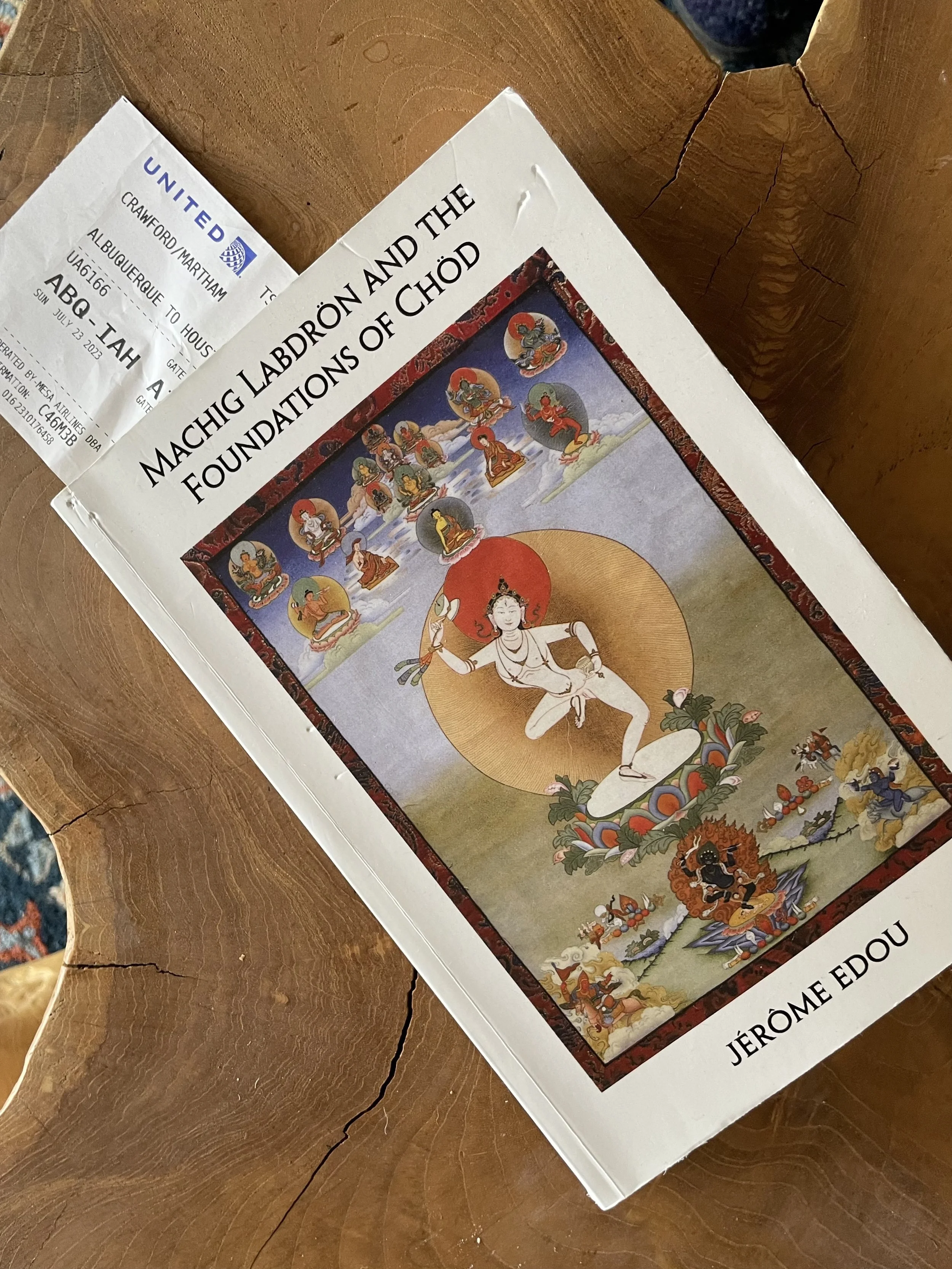
the book cover and boarding pass bookmark
I loosened the book’s spine, headphones in, N-95 on, as soon as I settled into a seat at the gate at the Albuquerque airport. I read through the flight, taking notes on my tablet, and through an unsettling night in a depressing “medical hotel” near to the hospital where I would meet with specialists the next day.
Early next morning, I looked over the twenty or so pages of notes I had taken:
I’d learned that Machig Labdrön was an 11th century lama, a wandering mendicant, in the region’s long tradition of “mad saints” who lived, taught, and performed healing entirely outside of established institutional frameworks. No monastery, no school, no printing house, no wealthy patrons.
Machig was an even wilder beast because she walked this path as woman. One who had left her vows as a nun behind, who had married, and who was a mother to a handful of children.
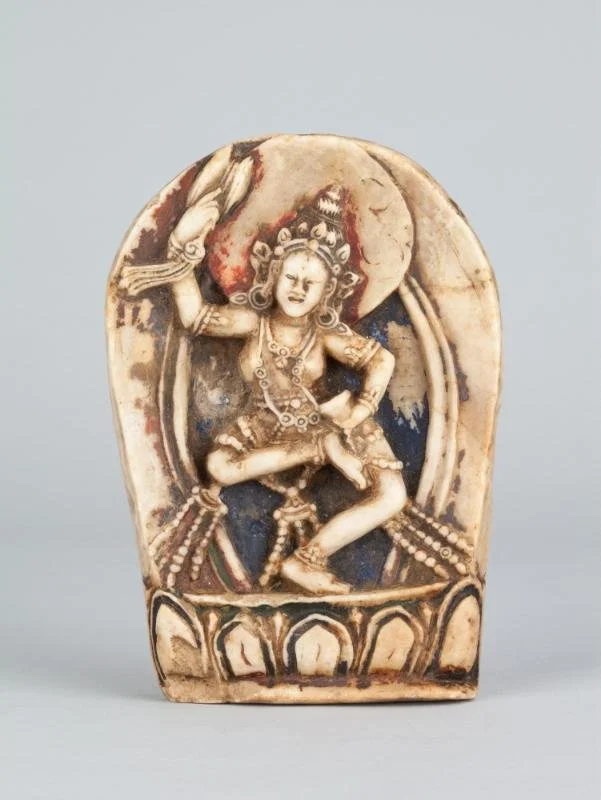
a carving of Machig from the Rubin Museum
I often complained that coming to terms with the terrors of mortality seemed a lot easier for the child-free men (or in the case of Siddhartha Gautama, men who had left their children behind) who had busied themselves pursuing enlightenment and founding world religions. I knew of no enlightened masters or bodhisattvas who had faced the horror of leaving young children behind, unprotected, unmothered. This was the first mother-Lama I had encountered.
Machig was called a witch, a madwoman, a reprobate, and a magician in the years after she started a family, and before she had been sufficiently tested and vetted by the gurus and lamas who finally accepted that her wisdom and vision was a great force: “a wild running forest fire consuming everything” acknowledging that her healings and teachings grew out of truly enlightened transmissions, visions, and visitations.
She took her students to sit in wild spaces to guide them in facing terror with equanimity: haunted houses, the nighttime wild, and charnel houses. Her most controversial teaching – often misrepresented in rumors as form of human sacrifice or witchcraft by those who spoke ill of her - was a practice of sitting in meditation and imagining offering up one’s own body to soothe the suffering of whatever demons had emerged to terrorize or distract from the work of enlightenment.
“Demons” here, is a name for any internal conflict or susceptibility - often triggered by external events – that blocks us on the path toward perceiving reality. “Attachment to any phenomenon whatsoever from coarse form to omniscience should be understood as the play of demons.”
Perhaps a more advanced sadhu could simply see themselves as empty, and their terrors as an illusion – but I’d never had much luck at facing primal fears with passive equanimity. Sitting still and letting it move through like a cloud in the sky never worked for me when my body was on fire with cortisol and adrenaline. But this Chöd practice, as I was beginning to glimpse it, considering my most powerful fears, inflations, longings, appetites as an agitated naga, a troublesome spirit, a wounded dragon screaming in rage and pain – and imagining myself actively tending to it, fulfilling the underlying need- this felt far more viable for me, more naturally instinctive, perhaps even more maternal.
Here the task was to try to glean what the injury was underneath the disruptive emotion or the possessing affect, to seek out the unmet need and feed it, tame it, transform it.
Here was my early morning demon in the hours before my appointment at the cancer center: Not the cancer. The cancer was just me, my own body over growing. The demon was my fear: fear of leaving my children just as they made their first attempts in a hostile world to leave home. Fear of the bodily pain and discomfort of intrusive tests. Fear that if the cancer had re-activated that medical expenses would consume our household’s security and resources. Fear that I would have to return to toxic brain-damaging medications. Fear that my end would only come after a great deal of suffering with hard to medically manage nerve pain.
I had befriended, tamed, allied with these fears several years before after a lot of work and a psilocybin journey, but if they were returning it was time to transform an enemy into a partner once again. I closed my eyes and imagined the fear, first as a dark cloud, and then as a whirlwind, as a powerful tornado sucking up everything in its path. I imagined myself lying flat on my back on the ground before this storm, surrendering to it.
I don’t know what makes you so great and terrible” I said to the fear-storm in the imaginal realm. “I don’t know why you need to take me over, steal my joy in the love and support of my family and friends. I don’t know why you try to destroy the meaning and purpose I have only lately found in my new work and sense of mission, why you need to make me tremble before you when we both know that life and cancer and discomfort are all temporary, and that death is exactly as natural and necessary as breathing and living. But there must be some reason you come to me in this shape of a screaming, spinning storm and I will not fight you. I will not pretend I am unmoved by you. I’m laying down before you to actively feed you whatever it is that you need. Go ahead. Consume me. Gobble me up.
“Take this offering until nothing remains of it.”
I imagined my body liquifying into a body of water, as the tornado passed over me, transformed into a waterspout, sucking “me” up through its funnel foot. As the storm consumed the liquid it moved more slowly, heavily, transforming until the puddle that had been my body was just a patch of dry soil with one silly looking puffy cloud hovering over-head. A bit of fluff that might have inspired Winne-the-Pooh and Christopher Robin to march in circles singing “Tut-tut! It looks like rain!” A small, refreshing shower in an otherwise sunny sky. My body went quiet and I rested there for a bit.
I wasn’t afraid anymore.
So- I might need to undergo some poking and prodding. So – the cancer which I’d been told originally was incurable but had given me a surprise remission might have come back. I was still five years ahead of where I had expected to be. So – I might need to go back into treatment, but there may be new options that were far less disruptive and burdensome than the ones that had gotten me this far. Or maybe there would be no need for anything beyond a blood test. The circumstance was wholly uncertain, and in this case, uncertainty was surely my friend. Who knew what would happen next? All outcomes were possible, natural, and none of them could destroy the love and joy I had known in my life.
I put on a big waistless raspberry-colored linen dress with no hooks or zippers that I had purchased for the occasion, and some lipstick to match and Catherine and I drove to the cancer center. I told Catherine I felt like dealing with the initial consultation on my own.
“So, text me once you know what is happening next and where to meet you for the tests” she said.
“Or - I’ll text you and you can pick me up when they tell me my oncologist back home was over-anxious and they give me the all clear!” I said as I hopped out of the rental car.
In the waiting room I reviewed my morning meditation: It would be okay, or it would all be okay. I’d had many more healthy years with my family and children than I had expected when all this hit, I’d been granted bonus life, and my kids were young adults, about to fly away. How blessed I was whatever happened next.
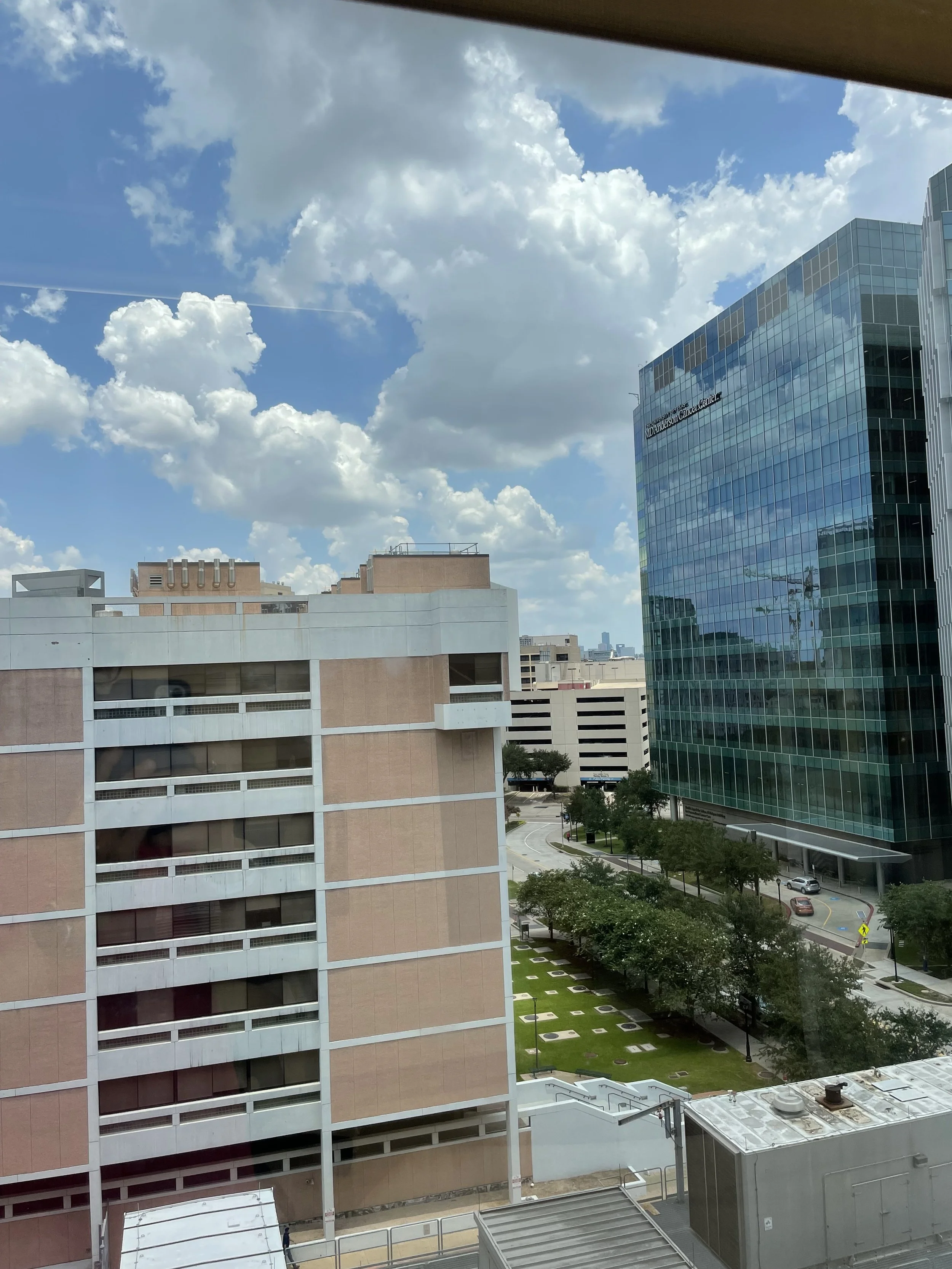
Finally, the doctors finished reviewing years of medical records and were ready to sit down with me.
They decided, as it turns out, that there was no real correspondence between a few funny white blood cells and what may or may not be happening in my cerebrospinal fluids. I had no concerning neurological symptoms of any kind, and the decision was that there was no reason to run any tests.
“It has been five years, the anomalies in your lymph are insignificant, and there is no reason to think that your case would require treatment again now, or in the future.”
I had not heard anything like this since the whole wild ride had started.
“We consider your case resolved.”
Resolved.
I sent Catherine a text to come pick me up and called my family and tried to process the fact that I was free. I shot out of that cancer center as if I had been fired out of a cannon.
Of course, I spent the rest of the unscheduled “vacation” week in broiling Houston digging further into the text and talking to Catherine about Chöd traditions and Machig this and Labdrön that, and mispronouncing everything. Talking her ear off and spewing strange words.
“See it is like a Mahāyāna or Pure Land image of Prajnaparamita – or in Tibet, Yum Chenmo which is a kind of Great Mother deity who has this perfect wisdom that can slice through illusion like a sword… But Machig didn’t establish any school, it’s really just a lineage, a passing down from teacher to disciple – But I’ve literally never heard these words before? Have you? I mean, I read a fair amount of Buddhist Psychology, and the differences between say Zen and Pure Land - and listen to Bob Thurman’s podcast – you know him - he is like the head of Tibet House over on West 15th? He’s Uma Thurman’s dad or something. But I’m not like, particularly informed, about Buddhism – I mean, I’m sure all this shit is totally famous in the world of American Buddhists – but that is just not my lane…
“ It’s a symbolic, pre-verbal, non-cognitive image-based practice. The unconscious/imaginal realm uses symbols to speak, so it basically speaking back through symbol—
“It’s like Jung says: ‘If you are chased by a bear in a dream, you must tip your hat and ask him what he wants of you!’ - I mean, it is basically that. It is just a method for joining our internal resistances, for getting to the root underneath a symbol or symptom or a conflict and engaging with the underlying need, integrating it, integrating your imaginal self into it. In Buddhist schemas the self is imaginal, illusory anyway, right?”
“Totally” Catherine responded. And I knew she understood me. But I also knew I was running on as I do when I get excited about new ideas, and I was filled with a giddy ungrounded freedom at being thrust into a cancer resolution - and that I was probably a lot before she’d had her morning matcha.
“The point is, and then I promise I’ll stop for now, is that it offers an active imaginal stance – right? Like Jung’s active imagination work, or like dream work – where the symbol is explored actively, deeply rather than a remote, removed detachment. If the bear is chasing you, you stop and take care of the bear.”
“I get it” she nodded as she blew on her hotel-room-coffee-station mug of hot tea.
PART TWO:
It took several months to assimilate into this new world – of a child free home after twenty years, and the release from a medical precariousness I’d lived with for the past seven.
I was glad for the strange new archetypal role model that had traveled with me to Texas, but the strangeness, transition and opportunity of every new day didn’t leave me much time for thinking about esoterica of Tibetan Buddhism.
I did facilitate a community discussion on the collective and epochal implications of dreams, and as I was preparing it did occur to me to look at and refer to some of the anticipatory dreams – of villagers and community members.- that preceded Machig’s birth as examples of collective dreams about collective events. That was nice. To stick a toe back in for a moment – but I’d finished the book I had – and other things were compelling my attention.
I had about fifty pages of notes, and I wasn’t sure what, if anything this fuss over an 11th century Mama Lama would amount to.
I identified not only with her methods, but with her “madness.” In my own way I also wandered in the in-between spaces, rejecting academia and psychoanalytic institute training, choosing to live without institutional support or status. I had left a licensed and practically vowed vocation as a psychotherapist to take up nameless work, led by hunches and a consolidating sense of mission that was hard to articulate and that wasn’t seen as particularly legitimate. Earlier in the year before all of this I had even dispensed of the traditional fee structure and was supporting myself as a kind of mendicant with a virtual bowl, working by pay-what-you-can donation, and offering my writing for free.
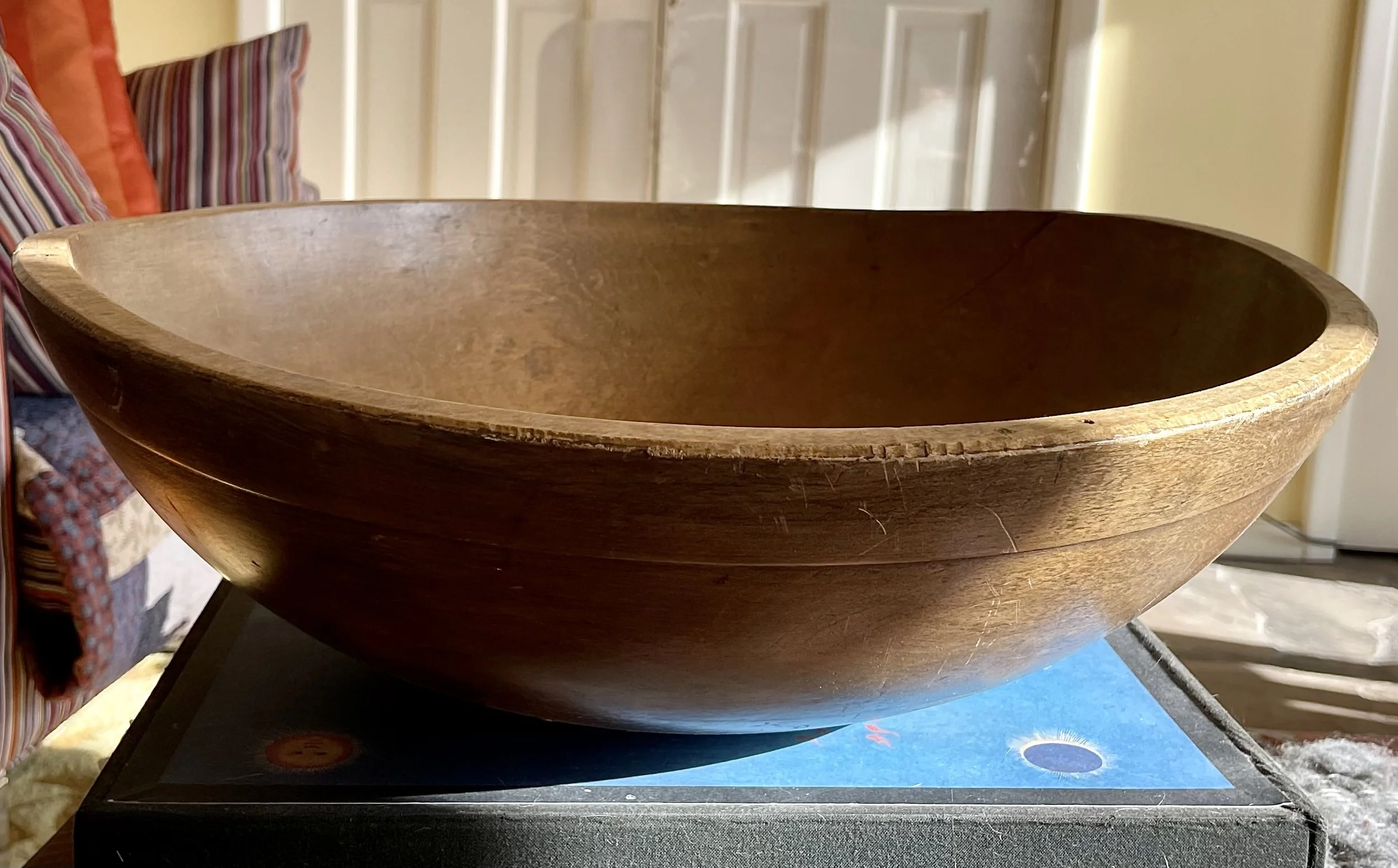
a hand hewn wooden bowl that was my mother’s and before that, my grandmother’s
Plenty of people had harsh judgements of what they saw as woo-woo and ridiculous about my interests, my business, and my practice. Some thought I had gone off the rails, offering title-less fee-less services, preferring to wrestle with cultural pathologies. No book deals. No essay pitching. No community college teaching gig. No patron. No institute. No status. No paywall. No good SEO on my website. Just people finding me who needed to find me and dropping what they can in my bowl.
Maybe that was enough to receive from exposure to Machig Labdrön as an archetype: a mother – seeker – teacher who put her life in fate’s hands and revered wisdom when she encountered it. Maybe it was enough to discover some company and to feel a little less alone.
But then things started to get a little shaggy.
According to my journal, December 1st, 2023, was a “restless” night. As is common when I have difficulty falling asleep, I put on a podcast called “Wisdom of the Masters” to contemplate myself into a dream and sleep state. When I woke up a few hours later, it was still playing and a new show, a new voice, an older woman’s voice was speaking. This woman was speaking in the first person, and telling a story of a trip she had taken to Nepal with a group of Buddhist student when she was sixty years old, to some temple somewhere with some Lamas in residence that honored Machig Labdrön.
I sat up and put my hands over my earphones. What?
She went on to tell about how they had asked her to sit in Machig’s throne-chair thingy, which she thought was strange – and how rainbows kept appearing which seemed pretty but not like such a big deal. But how at the end of her stay she was told that the Lama’s had anticipatory dreams that indicated that she, a white-haired woman from the US, would be arriving and that the lamas were sure she was an incarnated emanation of Machig Labdrön and the Keeper of the Chöd Lineage.
At sixty years old?
Here is me, holding my earphones to my head so I don’t miss a word, sitting up in bed in the middle of the night and I say aloud to myself - “No fucking way” - and it wakes my husband up a little, but I tell him to go back to sleep everything is fine.
I grabbed the phone and saw that the podcast auto play had flipped over to a show called “Wisdom Rising” with Lama Tsultrim Allione, a white American who was now anchoring Chöd practice in the U.S.
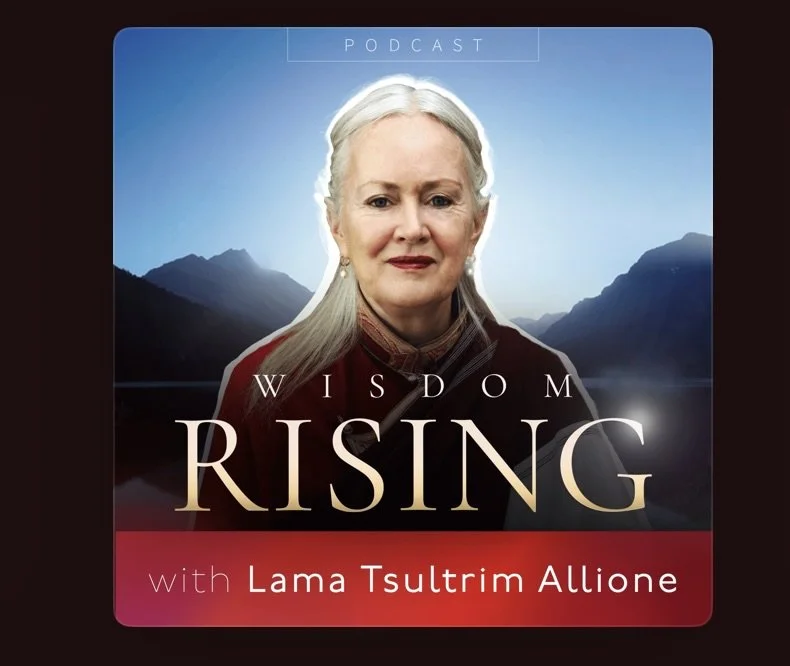
the photo that accompanies Lama Tsultrim Allione’s podcast
How strange. I shivered as one does in the presence of a mildly uncanny coincidence, and then felt a deep relaxing reassurance - about what exactly I couldn’t say – and fell into a very peaceful and pleasant dreaming sleep.
In the morning, I noted:
12/2, Dream fragments: Thoughts of how changes in our perceptions, and internal changes may generate or align with changes in the world around us. How intuition is a natural relational phenomenon and how the state of mind we assume is part of the matrix.
The words: Machig Labdrön appear in my dream, as if written by hand on ancient yellow paper. Underneath, other words seem to float all over the rough, yellowed page:
Facing Fears. Demon Feeding. Dancing dakinis. Chöd.
I am not actually a stranger to long synchronicitous runs of recurring symbols, to being chased around a bit by an archetype until it corners me and makes me contend with it. I’ve written other shaggy dog tales like this one before. And sometimes I think “what comes of it, is only whatever I make from it,” and so I write it all down and post it so at least I’ve honored it that way.
I try never to decide, or even try to discern what they mean. Sometimes when years have passed, the meaning becomes obvious in hindsight. But in the midst of it all, when signs and wonders are actively circling, I try to never consider what it means at all.
I just pay attention.
I did, the next morning, look a bit into Lama Tsultrim Allione. I re-listened to the episode about her recognition while fully awake. I looked at Tara Mandala, her retreat center’s webpage. I ordered a couple of her books to add to my stacks.
I felt no impulse to become a Buddhist or contact Lama Allione, although it was nice to realize her retreat center is only three and a half hours drive from home. Maybe it would be nice to go, now that the kids are out of the house, some day.
I told my husband about the “podcast incident” and he was as simultaneously patient and bored with me as he is when he agrees to listen to me recount my dreams. And of course, I called Catherine, who got to hear me babbling mispronounced names and words again, and who seemed slightly worried that I was going to run off and join a cult until I assured her I wasn’t. When I talked to my friend Janine later in the day, a practicing Buddhist for the last seven or eight years, who goes on annual Vipassana retreats - it was totally fun to imagine heading up to Tara Mandala together.
The shaggy dog story gets shaggier.
A few days later, when Tsultrim Allione’s book “Feeding Demons” arrived I posted a photo on social media and wrote: Looking forward to reading this contemporary interpretation of Chöd practice”
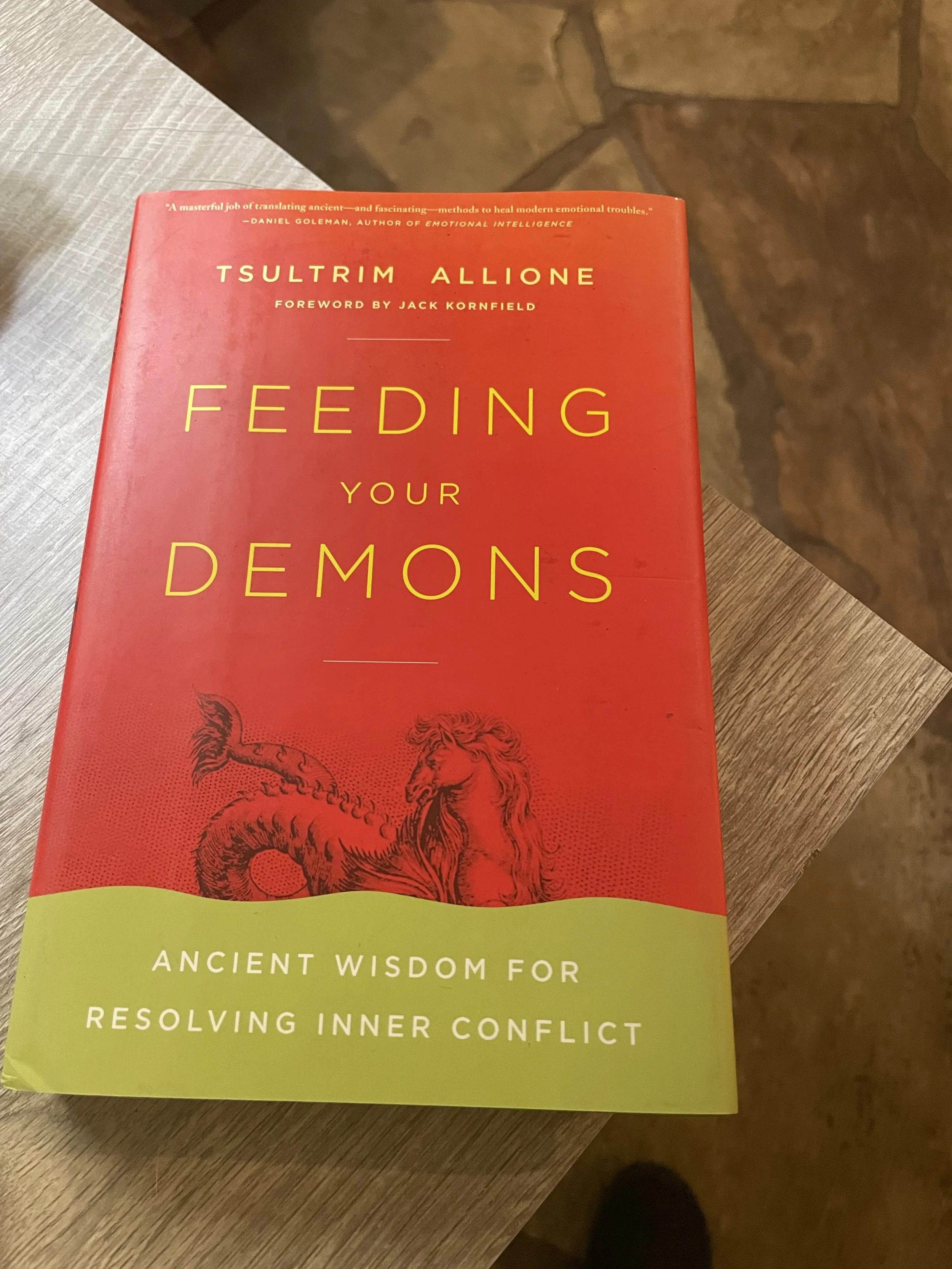
Lama Tsultrim Allione’s book about “demon feeding” practice
And Nina – another friend and colleague I talk to regularly on- and off-line and in group chats – relied to me online:
“I grew up with Lama Tsultrim Allione during some of my early years. I was born at home, and she was there with some other friends.”
“NINA!” I replied, “THIS IS SO NINA!” and called her immediately even though it was after ten.
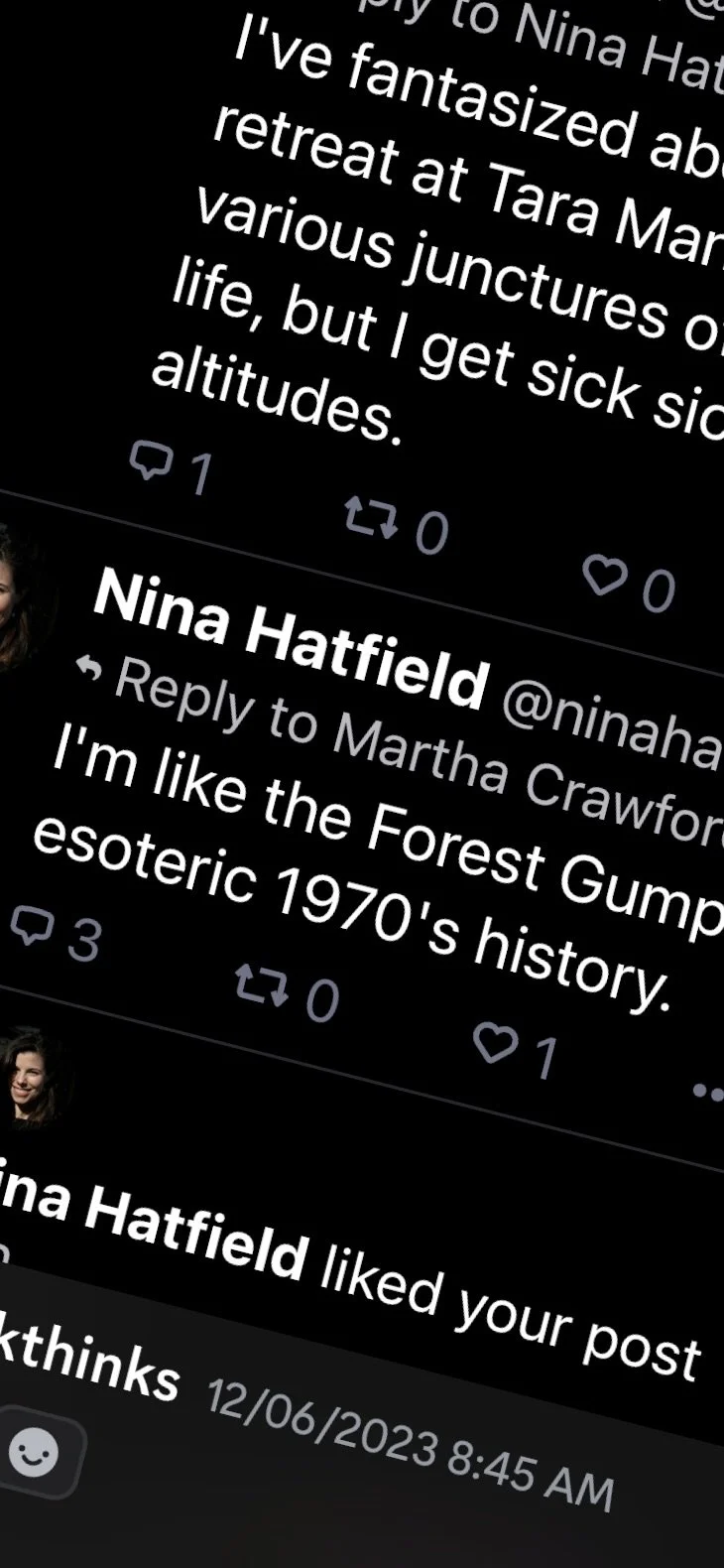
Nina and I chatting on social media: “I’m like the Forest Gump of esoteric 1970’s history!”
How did this get from there to here? How did a word I wrote on a piece of paper in the middle of cancer treatment lead to an 11th Century Lama, and then to a retreat center near my home and then right into the center of a circle of friends and colleagues that I’ve been spending hours with designing a retreat together? How did this travel from Tibet to New Jersey to Houston to a podcast in the middle of the night to attending the home birth of my good friend Nina?
This time when I told my husband I had another Machig Labdrön update he said:
“Oh no. I’m doing stuff. I don’t want to hear it now.”
“But this one is good.” I insisted.
“Okay. But make it fast.”
“You know my friend Nina, who I’m working on this retreat with, along with Elena, Gogo, Catherine and Janine?”
“Yes, I know Nina. Get to the point —”
“Lama Tsultrim Allione, a recognized emanation of Machig Labdrön—”
“Yes, I know I know, get on with it…”
“Was present at Nina’s home birth. She was there when Nina was born.”
“What? You are kidding! Okay! Now you’ve got me!”
That was only a couple of months ago.
If you want to “know what it all means” I must remind you that this is a shaggy dog story and here is the anticlimax I warned you about.
I have no idea and I’m not going to guess.
I suspect the answer won’t be clear for a long time, if ever.
I do know when this has happened to me before. My life changed entirely in ways that I could never have anticipated. I suspect such clusters and patterns emerge and a kind of herald that one chapter of living has come to an end, and another is starting.
Maybe this strange sequence emerged because I was already immersed in a dramatic life change – transitioning into secure remission and launching the kids into their adult lives.
Maybe the function of these synchronicities was just to confirm that there are bodhisattvas and guardian angels out there who have my back.
Maybe it is a reminder that somethings can only be recognized when you turn sixty (which I will in a couple months).
Maybe it’s a little blessing gracing the circle of friends and collaborators.
Maybe it is reassurance that all my bear-feeding, dragon-taming, demon-tending ways aren’t as novel, solitary or strange or “mad” as I’ve thought.
Maybe its just some company on the journey.
Maybe such clusters emerge merely to remind us that we live in a world of surprises —
but only if we pay attention, respect what we too often dismiss as irrelevant, and forgo our desire to fit our lives to straight lines that always come to tidy, satisfying conclusions.