Lectio #2: Brief Thoughts on Humility
NOTE: This is an essay that I am offering up here today “for free” that is usually behind a subscription paywall -
Seminar & Lectio is a twice monthly online subscription essay series.
One essay each month - Seminar - (for now) focuses on Jungian depth psychology and the varied theoretical, ethical, socio-political, and spiritual concerns that emerge from it.
The other monthly essay - Lectio - will focus on my personal reflections from the various archetypal, theological, mystical, and depth psychological texts that I happen to read for fun. I will share whatever lights up for me, and the contemplation that emerges from it.
This subscription series will gradually transition away from focusing Jung to writings about whatever I am reading and whatever has moved me. When I have finished writing through Jung’s Visions Seminars, (I don’t like to leave things unfinished) this subscription will be renamed & Scriptio & Lectio to reflect its new focus. If you would like to subscribe - click here.
I will continue to share writing - essays that I think of as more considered, less spontaneous, and less “intimate” without a paywall here at my essay archives as I have been.
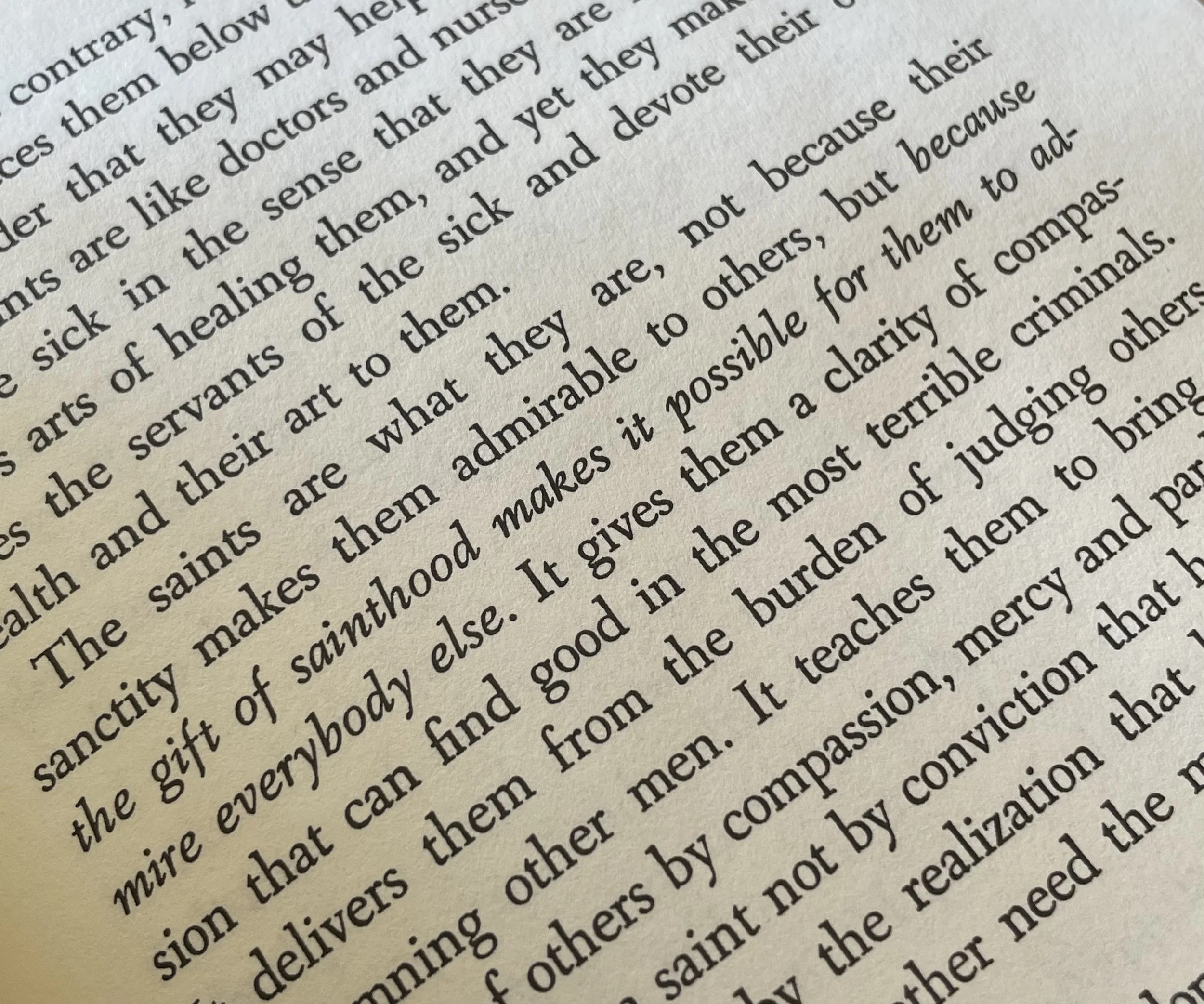
A photo from New Seeds of Contemplation: “The saints are what they are… because the gift of sainthood makes it possible for them to admire everybody else.
Sometimes nowadays, people refer to me as a “teacher” – not a schoolteacher, but some kind of “teacher” of adults. But it seems to me that to see oneself as a teacher, in the strange spaces that I work in – focused on mortality, spirituality, dreams, psychology, mysticism and liberation is utterly audacious.
I think of myself mostly a reader, and a digester, applier, and a conveyer of other people’s ideas – because most of what I pass on isn’t my own, didn’t come from me, and I don’t claim ownership over any of it.
I try to share ideas that I’ve received that helped me out of my own mess. I don’t like being idealized. It was the loneliest and most anxiety producing thing about being a therapist
My group chat among my friends we’ve been sharing links and commentary about the documentaries on Netflix and HBO Max about cults and the strange and frankly buffoonish cult leaders who capture the fascination of a community of people who regard these icky, obvious manipulators as “teachers” and “leaders” – and of course, our nation is on the brink of being taken over by the cult-like worship of Donald Trump and his MAGA/Q-anon conspiracy theorists army.
Also - I live in Santa Fe – land of strange New Age pseudo-Buddhist, pseudo-shamanic cults and cult-adjacent schools, programs and “healing centers.” And boy do I recoil from any kind of collective hero-worship or group-think. I wouldn’t even join a psychoanalytic institute because it felt too creepy. So of course, anyone thinking about me as a teacher or a leader of a community or a school of thought is not an idea that is comfortable or easy for me. I have actually spent a long time avoiding such things.
What might it do to therapists, teachers, spiritual directors, and clergy to have groups of people who find what they share interesting, useful, or valuable? Is it healthy? How might it be dangerous? What are the healthy ways to manage admiration and appreciation? What precautions are needed to avoid becoming ego-drunk, or group-possessed?
There here are some important safety mechanisms that I need to see in place in order to feel any willingness to engage with a teacher or in a group. These that need to be explicit and conscious in the psyche of anyone who is audacious enough to offer up ideas to other people, and explicit in the norms and practices of gathered communities to avoid dangerous pathologies.
Here are some that are important to me. I personally run for my life from groups and organizations when they are not present.
A refusal to cultivate dependency.
The celebration of self-regulation and autonomy.
Active and ongoing attempts to dismantle and de-escalate peer pressures.
The willingness to let people travel their own paths, to move away, step back, or leave entirely – with grace, celebrating graduations and departures.
An appreciation of challenge and disagreement and being overthrown in favor of other’s asserting their own core values.
And of course a handful of sentences that jumped off of the pages I’ve been reading the past two weeks - from men who were seen as wise, who had admirers, followers, students, and novices – and who worked to keep their own heads on straight as the collective pressed them into the role of Teacher - and who never claimed that the path they were walking was singularly correct.
The inspiring of the other person, bringing them to birth, without either entrapping them or attaching them to oneself - Olivier Clément, On Being Human
Humor is necessary for self-deflation - Olivier Clément, On Being Human
Humility comes before love. - Olivier Clément, On Being Human
When a proud man thinks he is humble his case is hopeless. - Thomas Merton, New Seeds of Contemplation
There can be intense egoism in following everybody else. - Thomas Merton, New Seeds of Contemplation
The saint is unlike everybody else precisely because he is humble. - Thomas Merton, New Seeds of Contemplation
Humility consists in being precisely the person you actually are before God. - Thomas Merton, New Seeds of Contemplation
God does not give us graces or talents or virtues for ourselves alone. We are members of one another and everything that is given to one member is given for the whole body. - Thomas Merton, New Seeds of Contemplation
We must find ourselves in other human beings - Thomas Merton, New Seeds of Contemplation
Remember that earth and all its living things, organic processes, and your fellow humans form a huge community of teachers.
To be precisely who you are before God – without hiding, denying, or erasing human failures, limitations, frailties, or cruelties.
To never require others, and certainly not a community of people, to protect you from experiencing your own inadequacy.
To find relief in the cool ground when you fall.
To enjoy being teased, being human, getting lost, and not knowing your ass from a hole in the ground.
To find joy in not knowing, in being reminded of your smallness, and to know that you are still worthy of love and connection even when you have no shot at being “right “or “good” in any given circumstance.
Idealization should make us anxious and uneasy. But healthy admiration doesn’t require perfection and doesn’t erase our vulnerabilities. It is safe and healing to accept and enjoy appreciation if you can also enjoy your failures and foolishness.
To accept being called out, called in, challenged, confronted, teased, mocked even – as great and generous gifts.
This is why humility comes before love – because in order to give it or receive love you must know why you need it, and how essential it is for us to share love precisely because we exactly as broken as everyone else - and how worthless and lonely it is to be “loved” only because you are seen as powerful or more intact than others.
To remember that things that others admire in us, are probably the least important things, and that our talents and strengths are just armor that can obscure our desire and ability to be seen, and to see ourselves, as as whole, heart-centered human beings.
Our unformed, unconsolidated, dis-regulated, stumbling, struggling aspects are the most beautiful things about our humanity, and the vulnerabilities that allows us to connect to each other. This overpowers no one. This allows others to travel alongside each other with their own vulnerability.
A broken and still beating heart is the most sacred experience of being human, and as long as we walk together on this earth we all have equal share in this.