LECTIO #3: Adjacent Possibilities
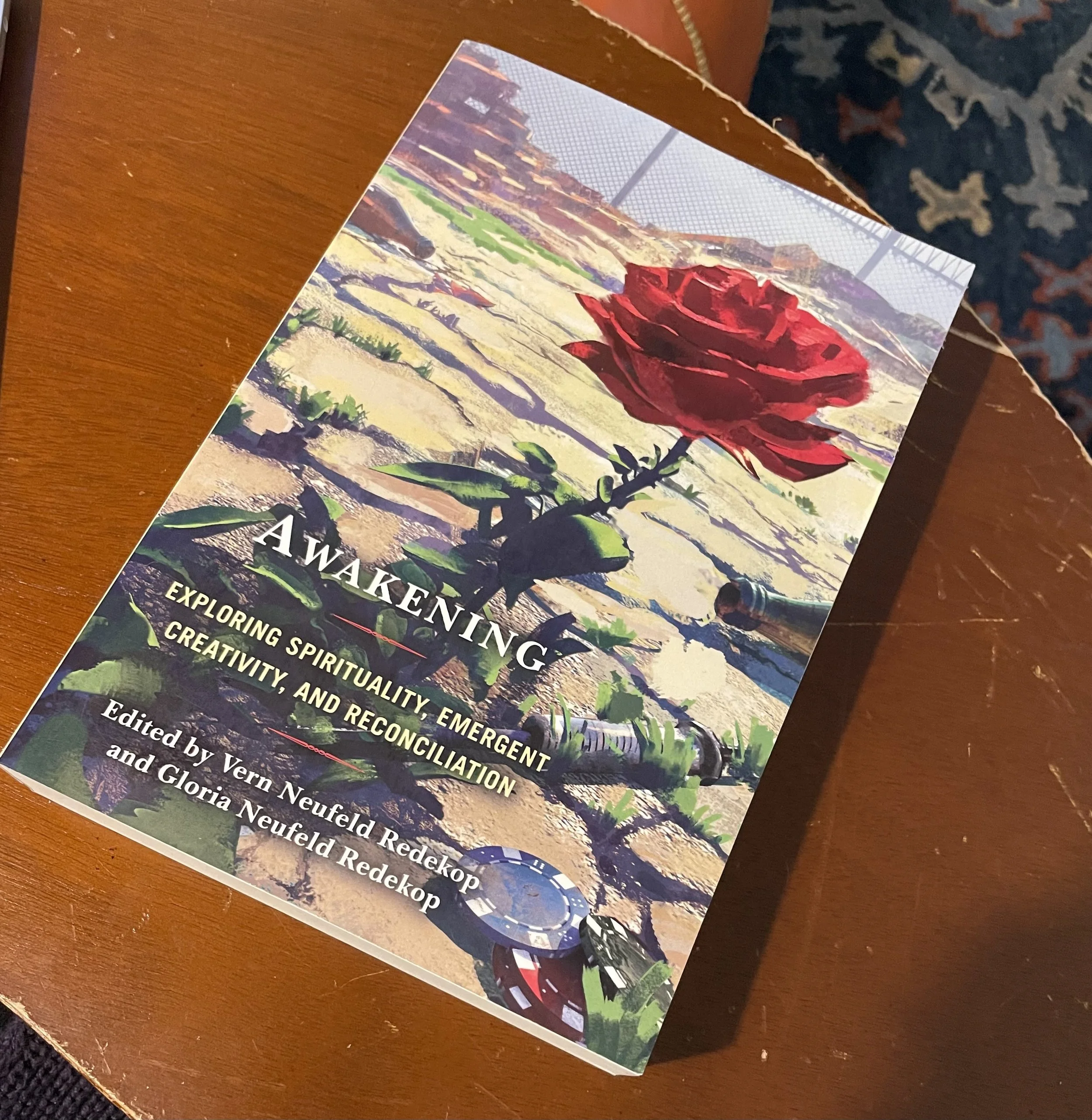
Awakening: Exploring Spirituality, Emerging Creativity and Reconciliation edited by Vern and Gloria Neufeld Redekop.
This is a “free” example essay from my Seminar and Lectio subscription. For more information about these by subscription essays click here:
I’ve been reading a few books at once: The first is Awakening: Exploring Spirituality, Emerging Creativity and Reconciliation edited by Vern and Gloria Neufeld Redekop. The second is God is Red by Vine Deloria Jr (you'll likely hear more from me about God is Red in upcoming months). For this reflection I'll be focusing on the first few chapters of Awakening. I name both of these texts here because they seem to be in dialogue with each other in the back of my head as they both call on their readers to reconsider simplistic linear notions of time and causality as we negotiate living in active relationship to a complex biosphere. I cannot promise that I can keep these texts from untangling themselves in my amplifications.
Both texts challenge reductionism and determinism as the predominant methods of knowing in the Global North and confront the ways these hegemonic models have devalued and colonized other ways of knowing. This to me, is extremely affirming as a large focus of my efforts in this world attempt to address the capacities for sensing and perceiving which seem to have atrophied in white American culture, and which in my view leave us sorely out of balance with the planet, other human beings and living things, and make the dominance of Global North a danger to both ourselves, to others, and to the biosphere itself.
For now, I'm going to try to write through my understanding of the second chapter of Awakening: Stuart Kauffman's The Re-Enchantment of Humanity. (all quotes cited here are excerpted from that chapter)
There are nuances beyond my comprehension, but also openings, glimpses of a world beyond our perceptions, as well as options for responses beyond naïve optimism or pessimistic doomerism.
The crux of Kauffman's chapter is simply this: Biology does not operate like physics. The forces of consciousness, creativity and complexity mean biospheres do not abide by calcified rules as objects and particles do. There are always stochastic possibilities in living things. In a biosphere we “do not know and cannot know what will happen. the future cannot be predetermined."
The desire to reduce the living world to simple formulas and taxonomies, to impose the notion that we live in a predictable world is a deadening, a smothering, a calcification of forces that are fluid and capricious. The biosphere is not devoid of magic, surprise, catastrophe or the miraculous.
By way of an example. Kauffman points out that only a tiny portion of all possible proteins have been created and that the possibilities that exist far exceed the time and space we have had on this earth to manifest them. There is more, far more that can be created, than has been, or will be created.
Life is an ongoing, unprestestable, non-algorithmic, non-machine, problem solving for survival, becoming.
A Winchester Mansion of obsolescence, closures, expansions, openings, and ever expanding, creative additions.
We not only do not know what will happen, but do not know what can happen.
Life is a becoming. All life. Plants, animals, insects, humans, bacteria and single- celled organisms, liminal entities like viruses, organic material are all capable of transforming, adapting, or asserting a dormant, underutilized variable which can change the entire system, through synergies and conflict in ways that we have never seen before, and which we cannot imagine.
We are always creating and destroying, and at best we have very limited awareness of the complex expansive chain of response and reaction. We may be able to anticipate a ring or two of potential causation, but beyond that there are too many potential variables to begin to calculate. To think we know all that we may generate and destroy with a single gesture is hubris. Given enough time and expansion, a ritual, a scream, an act of kindness or a dance step may change the orbit of the planet, and the trajectory of life itself.
We co-create this world alongside billions of other life forms.
In Kauffman's words: "We are a biosphere building itself."
We don't know what variables may and will transform everything. There are adjacent possibilities, "empty niches," unconsidered, yet to be imagined, or perceived that may seed new ways of being, housing the emerging creativity of a becoming biosphere. A biosphere is more properly a phenomenon than an object. We might guess at what could happen next if events flow forward from fixed premises. But if the ground we stand on continually changes in a plethora of ways, then we must admit that we not only "do not know what will happen. we do not know what can happen."
At most we only know a few possibilities that may happen in a world of nearly infinite possibilities.
This is what it means to live in a complex biosphere. To accept that we are surrounded by empty niches and adjacent possibilities To stand with humility with awareness of all the limits of our knowing, and to not merely fear the unknowability of what is to come, but to consider that this is also where our unknown powers and our hope resides as well.