Guide Stars
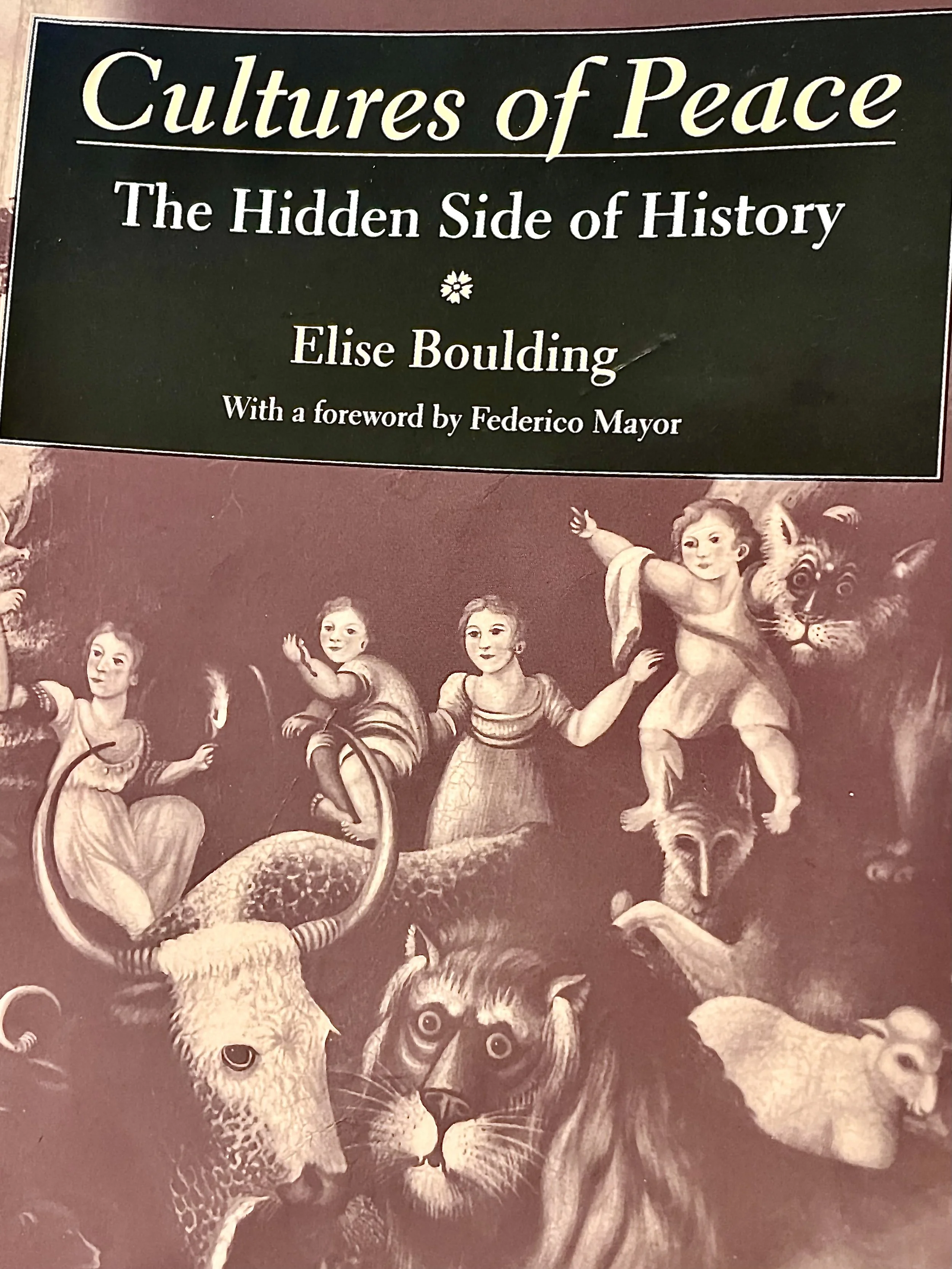
a sepia image of Edward Hick’s A Peaceable Kingdom on the cover of Elise Boulding’s book, Cultures of Peace, the Hidden Side of History
Monocultures are dangerous for both humans and for the natural environment. Cultural diversity is as important as biodiversity for the survival of the planet.
~ Cultures of Peace: The Hidden Side of History, Elise Boulding,
I’m sharing some reflections from sitting with Quaker Elise Boulding’s sociological studies of cultures of peace and warrior cultures.
“We cannot achieve what we cannot imagine.” is one of Boulding’s core precepts, integrated both into her theories, her research, and her peace organizing practices of what she called “utopic imagining.” She believed that consciously, actively and collectively imagining a better world, even an ideal world, was not a mere psychological escape, but an astute, instinctive critique of our current realities, a way to learn more about our unconscious and unmet needs, and as nascent form of strategizing toward building peaceable communities, cultures and nations.
A way to locate a guide star when we are lost and in despair.
Utopic imagining I believe, also offers individuals and communities essential moments of rest, psychological protection, restoration, hope, and consolation to those actively experiencing episodes and eras of violence, war and trauma.
Some psychologists might call this relief dissociation.
Religious folks might call it grace.
Utopic imagining is a kind of prayer. The kind that Quakers gather together in silence and envision togetherThe kind of prayer that a hungry infant in a crib, with no caretaker within earshot may resort to. A dream of being fed, of finding an oasis in the desert.
And mercifully, the baby’s consoling fantasy will coincide with an active spontaneous soothing gesture: they will find their thumb to suck, or some smooth satin trim to rub against their cheek, as soft as a mother’s breast. This is how psychoanalysis thinks about prayer without naming it as such.
The fantasy that moves us. The dream that guides us. In Salem they called this witchcraft. Utopic imagining is also the beloved community that exists here, now, among us, the Peaceable Kingdom, the Pure Land.
Sometimes we need to gaze far into the future, maybe even beyond our own lifetimes, to locate ourselves in a spinning world.
This is how I survive things, and this is how I love, and I wanted to read this text because whatever you call it, this is the only thing that has kept me going through periods of extreme challenge. And I also think taking up this conscious imagining together as a practice whatever/however/whenever – in silence, in dreams, through the creative works, through politics, through care work, through religious or secular contemplative practices, through community work, through talking with your neighbors or screaming through a megaphone, or standing together against state violence – sharing our visions of a healed world - is essential for getting us through the moment what comes next, and for building a reformed world from the aftermath whenever, however this all ends.
Because, these kinds of fantasies are a kind of mercy, and they lead toward opportunities for grace to emerge, from within, and among us all.
But not if we dismiss them as “unrealistic.” And not if we allow an excess of garbage, propaganda, threats, state terror and fear-tactics to fill our brains so that we can no longer hear our hearts.
It is hard to imagine more when we are tired beyond tired, when we succumb, when we are worn thin, when we are in the direct line of fire. But sometimes that is when it is most essential.
And it is hard to do alone. We need to hear each other imagining out loud and call our visions out to each other. We need to both keen together and hope together.
Groups characterized by power struggles, patterns of domination of the strong over the weak, men over women, by frequent physical violence and constant competition, and seeing nature as something to be conquered can be thought of as warrior (war-prone) cultures.
Whether we are oppressed or an oppressor in any given formulation and combination we are embedded in a war-prone culture.
High levels of aggression in civil society are associated with recent participation in war. The socialization for aggression involved in the preparation for and fighting of wars has subsequent effects on civilian behavior.
Recent participation in war? I tried to think of when I ever lived in a society that had recently participated in peace, and what the after-effects of peace-exposure might be.
Here is the truth: chronic exposure to violence makes us all worse, harder and meaner.
Free floating aggression effects language and behavioral responses in political life, in social movements (including peace movements) in sports, in visual and performing arts and in the media.
Boulding wrote this in 2000. There was no social media.
Boulding and UNESCO’s definition of violence is “the intentional harming of other’s for one’s own ends” - in other words, current business as usual. We are living in an extremely violent era, in an extraordinarily violent war-making culture. We are all effected by rise in the level of war-making, killing, violence, incivility and meanness in public life. We are all meaner, and more uncivil than we would be if we lived in a peaceable era, or a more peaceable culture.
I’m sure I am.
We are surrounded and filled with the language of holy wars. How do we redirect the war gods energies toward peaceful well-being?
Boulding not only believes cultures can change, she discusses the gentling practices that peaceable cultures enact. And as I list some of them below, I can almost imagine us gentling this explosive historical moment down a degree or two, taking a deep breath, providing more palliative care to those suffering including ourselves, and planting seeds for a better day. A break in the wildfire.
Peace cultures thrive on and are nourished by how things might be…
How can we move toward a just and peaceable community? How do we gentle ourselves?
De-emphasizing fear and mistrust.
Acknowledge our basic interdependence and oneness.
Make sure men are active participants in childcare from early infancy on.
Children, Boulding believes, serve a gentling function in peaceable cultures.
Share food and other resources.
Celebrate together.
Make art of all kinds. Sing songs, dance.
Consider what healthy constructed trust might look like, as a social project.
Handle conflict playfully, and as an everyday practice.
Encourage curiosity, flexibility and the ongoing development of new habits.
Remember the planet and all other living things are humanity’s teachers.
Value simplicity as a life-way
Play
Listen
It’s time to pray, dream, fantasize, envision, imagine utopically together.
And when that is too much for our weary souls maybe we can allow ourselves to search our dreams for a gentler moment and let it guide our way.