Bits and Pieces and the Hidden Gods
A long string of thoughts exploded in my head when read this single sentence in Jung’s Visons Seminars:
He tells a room full of analysts in training, and patients killing time in Zurich, of a woman who had a dream about a statue of a golden bull, that comes down off its pedestal and lays by her side.
"She is now just a cow." says Jung, “she is just her most animal self."
You see why I half-hate him.
A woman's most animal self is a cow is a rough and ugly sentence, especially considering some of the shockingly misogynistic utterings that emerge from Jung’s mouth and writings. The sentence is taken out of context surely, and but still, it felt like a slap, like all the animals women are reduced to when men speak to us with contempt: cow, pussy, bitch, dog, pig.
But then I breathe and breathe again more deeply. What is underneath? Something important is underneath… We are in a dream. A bull god has come to her as a tamed ally. She is not “just a cow” – Bull gods don’t select domestic cows as their allies. She is a Cow Goddess: Bat, Hathor, Kamadhenu, Hestat, Phaethusa, Boan and more forgotten probably, than were ever recorded. Goddess of fertility, nurturance, power, dignity.
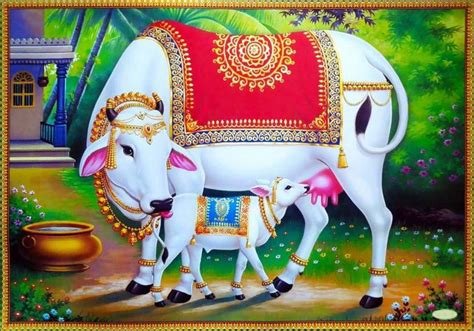
Supremacy, patriarchy, and Christian fantasies of dominion over the earth turn "cow" into an insult. A mere breeding cow. A possession. An enslaved, debased, corporately farmed creature, stripped of its agency, its opportunity to run, to rear its young. A wholly dominated creature valued only as its body and udder produce food for those who own it. But the cow goddesses are rightly revered. As are the Tiger Bear, Snake, Spider and Turtle Women, the Mama Lions, and the rebellious undomesticated women of the night - the silly old bats.
They all have their dignity and their powers in this world.
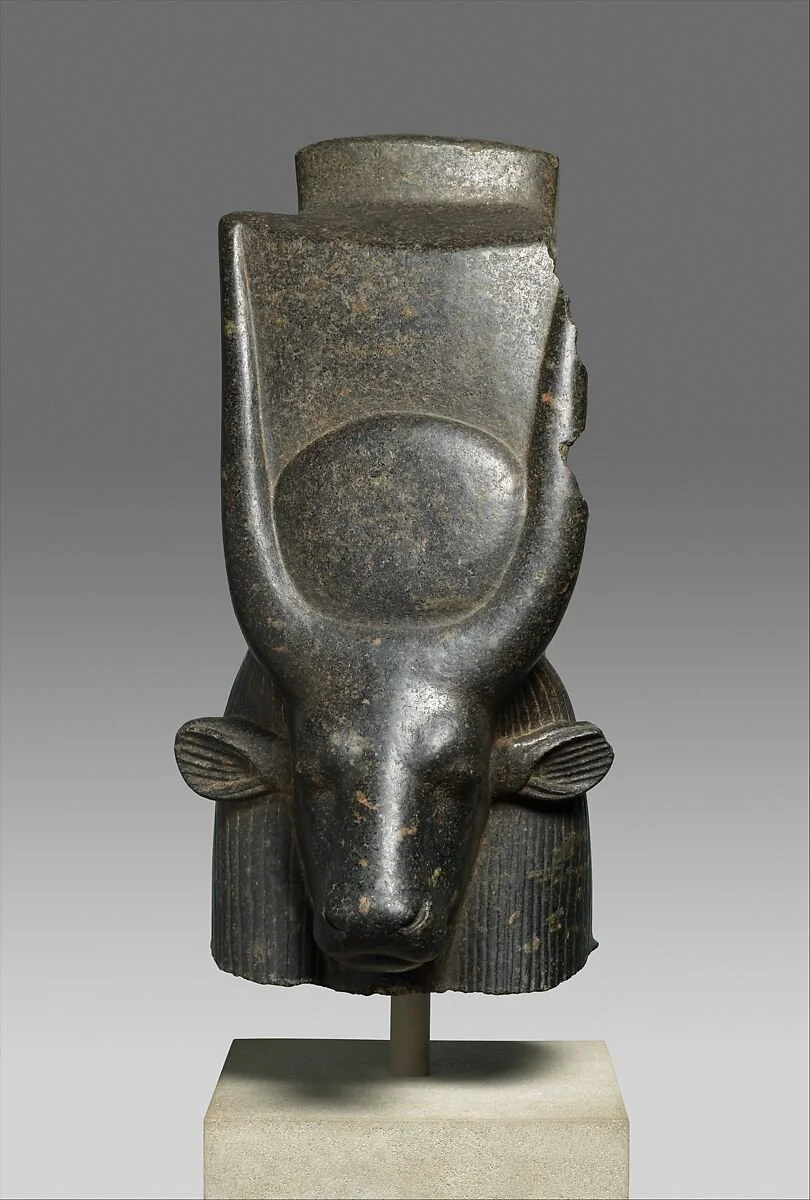
How do we resuscitate the integrity filled archetypes that live behind reductive stereotypes?
I've come to wonder if archetypes always degenerate into hackneyed tropes and oppressive stereotypes as they die and fade away. And yet, they seem resurrect and resurface in indirect and even hidden ways through our popular culture, transformed into super powered warriors in movies and comics: Mantis, Vixen, Cat Woman, Black Widow
Do the goddesses lurk in there in new costumes? And what happens when our dreams pick up an oppressive stereotype or a reductive trope and look underneath, and through it, attempting to call forth a fragment of an essential archetype?
My mother scolded me whenever we moved into a house new to us, and we moved a fair bit, because my first act in getting to know the place, my new bedroom would be to pull up a corner of the wallpaper or scrape off the topcoat of the new paint and pull up a tiny corner of the carpet or tile to see what was underneath. How could I make myself at home if I didn’t know anything about what had come before?
A house, to me, felt like the entire accumulation of the layers of life lived there, the sediment, the remnants. And I think the same is probably true of both the beautiful, cruel and neutralized symbols that we apply to each other and live among.
Underneath the joyful tune of the ice cream truck lurks a forgotten minstrel show lyric mocking newly freed Black men. What if the histories of cruelties, horrors, honor, beauty, and resilience are all present in every symbol we reach for to express ourselves or understand each other? What if the happiness of children and the violence of Jim Crow all remain alive in that melody? How can we honor the whole continuum, the shames, blessings, cruelties, and sacred powers? How do we tell the stories of powers that always seem destroy as we create, and create new forms from the destruction?
Maybe stereotypes kill archetypes and after they fade new archetypes arise from the ashes. Dying stars collapse into black holes that then exert their own force and influence on the galaxy that surrounds them. But to let the goddesses and gods simply deteriorate, to devalue their powers and erase their dignity is surely a sin.
Better to forget them entirely.
Yet even in forgotten things the old myths live on: Like the little stork scissors that lay overlooked in your sewing kit, or maybe your grandmother's: Gold plated scissors, a stork carved upon them, the screw for eyes, and the blade as beak.
These:
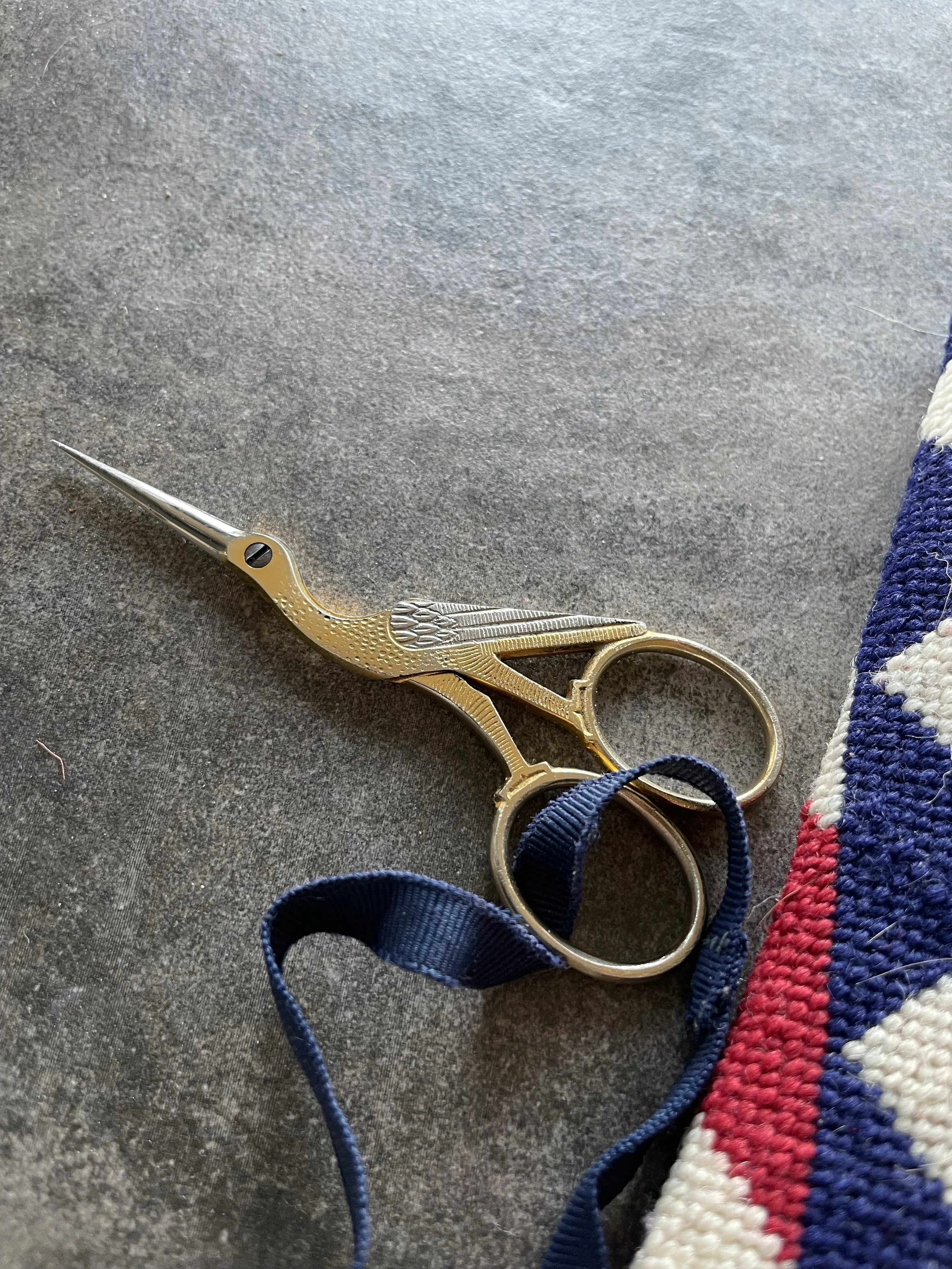
These scissors, for embroidery and textile work have a longer history than a trip to a fabric and notions store: They are a fading myth, that has been forgotten, but not degraded - preserved with some sufficient minimal respect:
Midwives in the early 19th century relied on stork shaped forceps, clamps and scissors as the primary tools of their trade. Once called the God Bird, storks – like midwives themselves - were seen as escorts for souls traveling between the worlds.
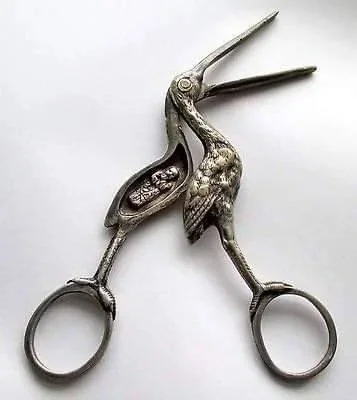
Farmers wives, household seamstresses, women who have made their children’s clothes those who knitted mittens and stitched wedding and baby blankets all over the world have very intimate relationships with their tools. Those little scissors, sit in the sewing kids and notions cupboards and craft stores. Your friend who does cross stitch may have a pair too. And without knowing it they reach back into ancient Egyptian, Greek, German, Norse, Hebrew and Chinese mythology every time they snip a thread on piece of clothing or textile that has the potential to outlive the soul they have made it for - an artifact, a symbol of a time we have forgotten but that continues to haunt us as we negotiate birthing and dying: reproduction as community care, dying as community care and those who midwife us from one era to another,
Our multiple histories live in the traces of these symbols. Severed histories, and the voices of the dead are preserved, dormant, in forgotten histories that sit right in front of us in plain sight.
Eras come to close and new eras are born, but leave their symbols behind, waiting for us to recognized them, waiting to be reactivated and called forth when they are needed, and when we are curious enough to notice them.
We live tiny little lives, but we are embedded in a great chain of earth and matter, archetypes, myths, stories, and life. The under-stories matter, and the distortions and erasures matter too. They are as alive as the magical stories of childhood scars that have lived on our bodies for as long as we can remember.
The story unfolds and we are part of the story of the Universe, a piece of something too large to comprehend. The messes we make, the compassion we summon, and the shit we do matters, and embeds itself in the continuing story through to the next big bang. All the bits and pieces, all the minerals and DNA bits and all our molecules and particles and our souls and their components have been there – assembled from traces before us, leaving traces after. Ashes to ashes. Chicken to egg and back again.
Is it better to remember? Or forget and let it rise again? Searching out the old gods in the world around me comforts me in the face of our amnesia and our failures.
A reminder that nothing essential wholly disappears.