A Mendicant’s Bowl
If you would like to donate to support services for those experiencing financial hardship, or to subsidize this free newsletter, you can make donations here.
Our relationship to money is our relationship to fate. ~ Russell A. Lockhart
A decade or so ago, I wrote a few essays examining my relationship to psychotherapy and money. I did my best to reconcile my values, the standard practices of my profession, the costs of raising children and the overhead for office real estate in New York City. Strangely these are still some of the most read essays I’ve ever written- links popping up in chat rooms and list-serves for clients and therapists.
And although I’m glad if those essays are useful for others, and some of it still resonates for me - I don’t do it that way at all anymore.
When I read them now, I feel how tired I was. I never wanted to work exclusively with white, worried, wealthy, people. With my own experience of many decades of living in actual poverty, it was essential for me to build a practice that was financially inclusive and socioeconomically diverse. So many of my peers thought that I was going to extraordinary, even excessive lengths, bending over backwards to live up to some value that simply had nothing to do with running a successful freelance business as a self-employed professional. Life would only get gentler if I charged more, saw people with “easier” problems and more social support, and worked less.
I never entered into a contract to supply peace of mind for money. ~ Arwind Vasarada
But I couldn’t play out that equation. I always tried to see a few people for a token fee or for nothing at all - okay, honestly - it was always more than a few, more than a handful even, more than was financially prudent. I saw many others for what was considered by NYC standards to be a low fee. And I tried to book enough people for my full, high fee slots that it would all come out in the wash. I created elaborate formulas trying to figure out how many pro bono and low fee clients I could see and how many spots on my caseload would need to be top fee. Every year rent and costs increased, and I would try to pass those costs on to my clients with small but steady annual fee increases for anyone I thought could afford it at all. The result was that I worked many more hours than most of my peers, but was able to do work I cared about and somehow pull my financial weight.
Money comes to us marked, marked with the soul struggles of the “other”.... Money is another kind of blood and when it circulates through our hands it comes perhaps with more than we know. ~ Russell A. Lockhart
But the strain of trying to “figure out” who was under or over paying me left me feeling caught up in some kind of policing and created a resentment in my work that never felt right. People with far more assets and disposable income than I would ever have - would ask me to reduce their fees. Others out of guilt, anxiety, obligation or affection would try to pay me more than they could afford until it became clear to me they were hurting themselves and I would reduce their fee. Insurers would impinge and impose themselves on a process I hoped to keep them out of by dropping my fees.
It was assumed that “good therapists” would charge necessarily high fees, and sometimes the inverse too - high fees reassured therapists that they were “good” at what they did. You get what you pay for, right? But no matter how transparent, de-mystifying, flexible, generous, inclusive, self-regarding, clear-cut and pragmatic I tried to be - I could never find a way to reconcile my desired relationship with money to the work or the world around me. I didn’t mind talking to clients about the ways that finances reflected and impacted our relationship to each other - but the chronic capitalistic pressures too often made me choose between hating my work, or hurting myself with overwork.
I didn’t want more and more and more. I didn’t want to reach the pinnacle.
I only wanted enough for myself and enough to share with others.
Being neurologically terrible at math and keeping simple records didn’t help either. The most basic bookkeeping was a suffering - and no software or billing assistant could protect me from my own visual perception disorder. Simple addition and multiplication was (and are) nearly impossible for me. Dyslexia/dyscalculia left me struggling with my accounts, calendar and bookkeeping every month, failing to charge for sessions, inverting numbers on DSM, ICD-9 and CPT codes for clients who wanted to submit to their insurers, forgetting to delete cancellations from accounts, checks deposited but not credited, outstanding balances regularly miscalculated in anyone’s favor.
Extraordinary demons are startled when the money complex is touched. ~ James Hillman
And through all of that collecting and accounting and formulating and over-working and over- and under- charging and impossible New York City money drama I imagined a simpler life: A vision of a beautiful hand hewn bowl sitting on a low coffee table between me and the client. When the session is over, the client places whatever donation feels healthy for them in the vessel. A dream of being paid for my labors, but fee-lessly.
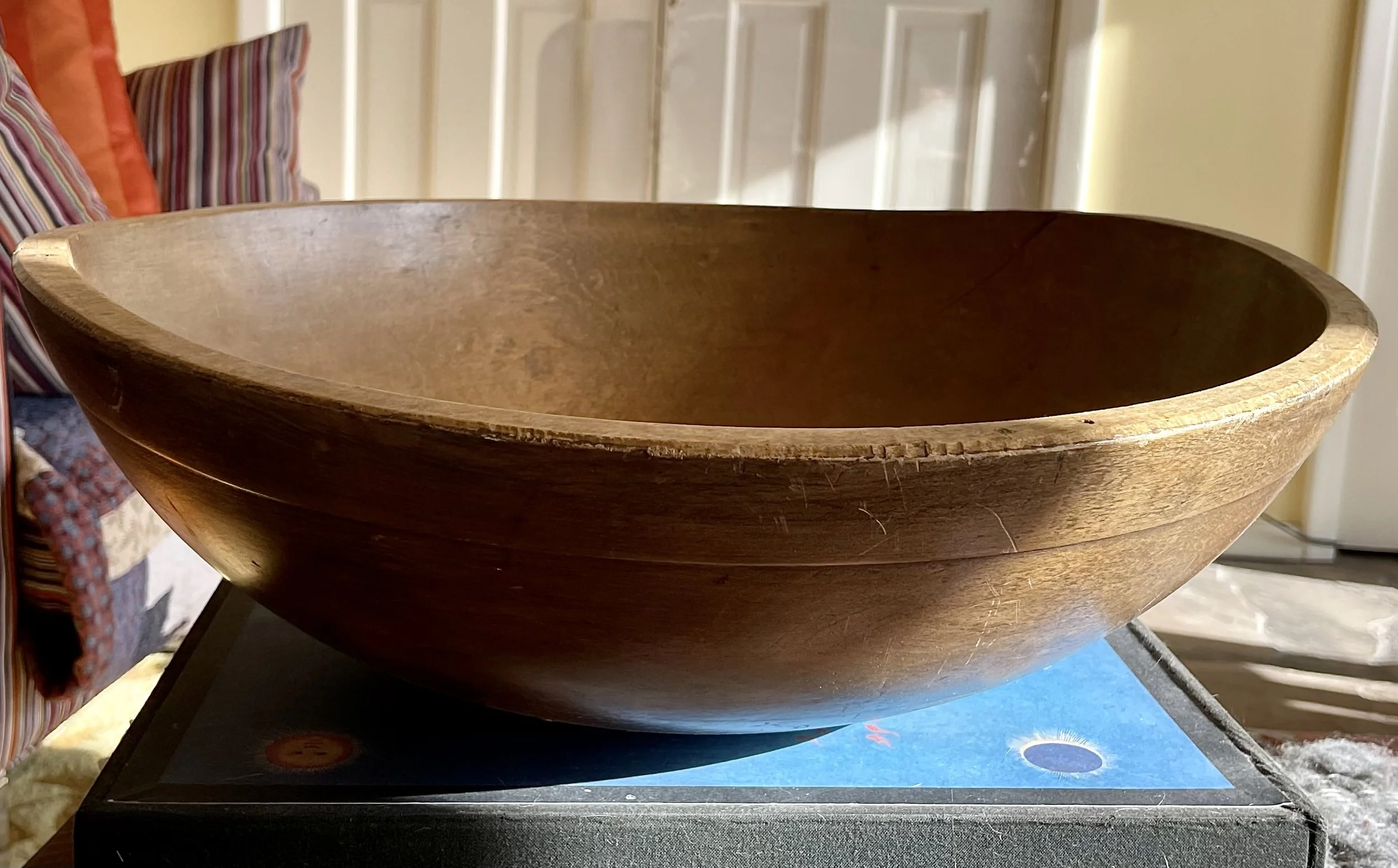
a hand hewn wooden bowl
And of course, it all collapsed. Cancer can transform dreams into imperatives and wishes into necessities. And although it took me some time, to escape the city and its expenses, to shed an outgrown professional identity and model, I was eventually able to find a way to engage in unnameable work, without an office, without overhead, exclusively online. I began to gently ease into an entirely new relationship with money.
As the pandemic descended, the desire to help community mental health providers - and by extension their clients - motivated me to to form a series of “pay-what-you-can” peer support groups. I imagined I would be donating some part of my services, but covering my expenses. But then I realized the by-donation groups took fine care of me. I didn’t feel drained. I didn’t feel ill-used or resentful. My energies felt valued and respected. People could pay what they could afford without feeling ashamed. People who could pay more could subsidize others who could pay little or nothing. Perhaps some were paying less than they could or should but what business was that of mine if my needs were met? Probably they would get less from a process that they undervalued - but that was their dilemma, not mine.
I realized that the “standard fees” that I’d set for decades were arbitrary, that they evoked resistance, fear, suspicion, inadequacy and shame in both myself and those who sought me out.
So I just let it go.
“What is your fee?”
“Just pay me what feels right to you, that won't hurt you and will make you feel invested. Whatever that is will be fine.”
And I was fine. I didn’t need a predetermined fee, and I didn’t need to haggle, or negotiate or wonder how much others could or could not pay. I stopped assessing people’s financial circumstances to determine payment. I quietly, incrementally incorporated the language and practices of “by donation” services. I stopped telling people what the fee was “supposed” to be. People could pay proportionally from their own financial circumstances without feeling shamed that they could not afford my care.
It was all just fine. My income did not change dramatically in any way from when I struggled with a traditional fee structure. And I extricated myself from many tasks that I loathed. The people who came to see me can and could be trusted all on their own, to determine what they could invest in the process, on the honor system and I could trust that the work would take care of me too.
You will be cared for always if you feel into the trust you had then as an infant. You will not feel lost. Just be nothing. Be free from all ambitions and desires. Don't ask for any fixed fee, accept what is given freely and happily. ~ Arwind Vasarada
Some people who come to see me find this extremely anxiety provoking. They worry I will feel devalued or offended or that they may inadvertently “low ball” me. Some people cannot calculate what they “should” pay me until I tell them something about the average donation range and reassure them repeatedly that I have found a way to work that both takes care of me and others. Many others seem to feel much safer coming to me and asking for what they need. When I have more people in need than I can carry alone, my community has come forward to support the work - offering donations for scholarship funds or to allow me to hold space for those who need pro bono care. I have met some extraordinary beautiful souls that I would have never encountered with an arbitrarily set fee sitting like a barrier between us.
Stories about money fall short of the truth. The stories are a personal mythology. ~ Adolf Guggenbühl-Craig
There are many layers of privilege that have allowed me to step past this fear - knowing that my partner could compensate if I took this step and plummeted allowed me to cross what had previously seemed to be an un-crossable line. And there are issues of illness, disability and limitation that made it mandatory to find a new way to work in order to survive. But I did not plummet. It all stayed about the same. And somehow, I am able to hold out my imaginary mendicant’s bowl, giving away whatever service I can, engaged in work I love, knowing when to stop, resting as required, asking when I should, receiving what I need, accepting what is given freely and happily, forging a new relationship to fate, and being grateful that enough is truly enough.